The birthrate shredder
We ‘hurl defiance to the stars’, but in their silence—when we see them at all—the stars return only crushing contempt. To the question ‘What is to be done?’, then, she can legitimately answer only, ‘Do what thou wilt’—and ‘Let go.’ — Unconditional Accelerationism as Antipraxis
Part one
Any civilization that denies immigration — and I don't just mean "selective amounts of immigration from preferred, equally rich countries", but essentially/full open borders immigration/, particularly from developing countries — is going to*literally die.*
This is not some wishy-washy, politically correct argument based on how "important" racial diversity is for a variety of perspectives; nor is it merely a concern that we might miss out on a one-in-a-million genius. Rejecting open-borders immigration essentially guarantees a completely unavoidable, teleological demographic and eventually civilizational collapse. It is an accelerating asymptotic process that locks on to civilizational annihilation.
Birth rates
The reason for this is simple, and it's one countries as diverse as China, France, and Japan are facing right now. The future is here, it's just not evenly distributed yet.
As a nation gets wealthier and more educated — as GDP per capita and educational attainment increase — its birth rate inevitably declines. While we don't fully understand all the nuanced sociological, economic, and cultural reasons for this, it is an observable pattern across time and across a vastly different number of countries and cultures.
There are a number of reasons for this: one, the richer and more educated a population is, the busier they become engaging in their careers, educating themselves, and actually enjoying the fruits of that wealth through travel, personal projects, and self-fulfillment. The insane time and wealth investment of having children, which can temporarily or even permanently grind your entire life to a halt and redirects your focus from attainment and enjoyment towards the well-being of others, becomes a stark contrast to a life of personal freedom.
Then, at the same time, the traditional incentives towards having children essentially evaporate. You no longer need kids to support you in old age, as personal savings and the general social safety net take over that role. You don't need children to supplement your household income because a high GDP per capita means one or two incomes are enough to maintain a household. You also don't require the extra labor around the house that children used to provide on a family farm, because we actually have services and automation to handle that.
Furthermore, as people become wealthier and more educated, they tend to move into more urban areas where the amount of available living space decreases, meaning you simply don't have the space for children to naturally play and grow.
But perhaps the most complex and powerful driver of this decline is the skyrocketing cost of competitive child-rearing. The more rich and educated everyone else is, the more resources parents need to invest in each child. As a result, people start having fewer kids in order to gain a competitive advantage by focusing their resources more on the children they do have. Then everyone else starts being forced to have fewer children because they know that/their/ resources would be spread entirely too thin between them. Then, because everyone else in society is doing this — and has the wealth to back it up — the baseline requirements for a child to succeed become incredibly demanding. As a result, you enter a spiral of helping your children keep up with everyone else's children becoming more and more expensive and so people having fewer and fewer children until you reach a point where those who feel like they couldn't keep up in the amount of resources they could allocate towards their children start to not want to have any at all.
There is no natural stopping point to this decline because it is essentially a collective action problem. Everyone is making the individual decision for themselves, and you cannot force an entire population to simply even out and increase how many children they are having.
Pro-natalist policies
Some argue that government intervention can fix this through positive financial incentives, but if you look at countries with "gold standard" semi-socialist pro-natalist policies like in Scandinavia, which provide things like a year of paid leave, universal high-quality childcare, and massive subsidies, you still see abysmally low birth rates. According to the Nordic Statistics Database, "In 2024, fertility rates were at record lows in Finland (1.25), Åland (1.29) [1], Iceland (1.56) and Sweden (1.43). The rates in Faroe Islands (1.91) and Norway (1.44) were marginally higher than in 2023, when record lows were reported there (1.87 and 1.40, respectively). The Danish rate is also low (1.47), although still at a higher level than in the early 1980s. [2] For Greenland, 2024 values are not yet available, but the 2023 value (1.77) was also the lowest total fertility rate reported." So, while their birthrates are not as bad as somewhere like South Korea (at 0.72) or Japan (1.2), you see the exact same decline in their birth rates overall: they're all still below the replacement rate of 2.10, even below that of the US at 1.62 (which is mostly propped up by first and second generation immigrants as it is — if we just counted white people, it would be 1.51) and far below the birth rate of, e.g., Sub-Saharan Africa at 4.60 —/and still shrinking, like every other developed country/.
What about just/giving people money/, instead of providing services, like a sort of baby-UBI? Hungary tried that. Since 2010, Viktor Orban’s government has spent nearly 5% of its GDP on birth incentives, literally more than double its defense budget, and what did that get them? A one time baby "boom" in 2021, pushing the birth rate from 1.2 to… 1.6. And by 2026, it's right back down to 1.36.
People/just don't want babies/ when you give them another option. it's not a political or economic thing — something you can fix by making having babies easier, or cheaper, or even compensating people for doing it. It's a fundamental cultural result — across wildly varying cultures — of increasing wealth, education, and technological sophistication.
When incentives fail, authoritarian regimes often pivot to restrictive pro-natalist policies, such as banning birth control and abortion, or even attempting to force people to have children. These policies are not just profoundly unethical, though. They, too, are also profoundly unworkable.
If a government bans birth control and abortion, citizens are forced to weigh two options: endure the massive, life-altering costs of raising a child, or completely avoid having one. People will overwhelmingly choose the latter, either acquiring contraceptives through illegitimate means, or simply stopping having sex altogether. You can see this exact resistance playing out in real-time with the 4B movement in South Korea, where women are engaging in a massive reproductive strike; more broadly, that kind of environment is certainly a factor in what has led South Korea to have one of the lowest birth rates (0.72) in the world.
Attempting to directly force people to give birth is an even greater administrative nightmare. If an authoritarian state wants to forcibly*prevent* births, like China did during the One Child Policy, they can abduct pregnant women, force an abortion, and sterilize them in a single, brutal intervention. As horrible as it is, it's relatively practical if a state is motivated enough; it's a "one and done" atrocity, and the state never has to pay attention to them again.
But if a state wants to force a woman to/give birth/ for them, the logistical burden is astronomical. The state must continuously surveil her for the entire nine months of her pregnancy to ensure she doesn't terminate it, and then surveil her for years afterward to ensure she actually feeds and cares for the child. If the state takes the child away immediately after birth to raise it themselves, who is going to feed, clothe, and raise that child? Maintaining a massive network to raise a generation of forcibly born children is a fuck ton of work, and it is entirely unsustainable, because where are you going to get women willing to do it who are actually lactating just for one example? I realize this is crude and cold, but this is the reason even China isn't attempting it. Evil at this scale isn't just wrong because of moral reasons, it's also usually fundamentally completely impractical and unworkable, and it's worth pointing that out from time to time because otherwise it becomes easy for people to justify the evil of an atrocity by pointing to some imagined state where it works.
Even if resistance to state banning of birth control, or state-mandated forced birth, succeed: you'll end up with a situation like Romania's Decree 770 under communist dictator Nicolae Ceausescu. While the decree/did/ lead to a temporarily massive spike in births the year after (1967), it also led to maternal mortality skyrocketing*because women restorted to unsafe illegal abortions*, and ultimately the state couldn't care for those children: after the regieme fell in 1989, it was discovered that to hundreds of thousands of children were living in horrific underfunded state orphanages, because their parents had abandoned them,/because those parents had been forced to have children they didn't want/. This didn't help Romania; if anything, it strained their entire social fabric even more.
A similar approach would be to roll back women's rights: ban all reproductive control and planning, repeal no-fault divorce and marital rape laws, ban sex before marriage, perhaps even allow men to have multiple wives. The problem is that this strategy is not just evil, but also unworkable. Even if a reversion to a more toxic patriarchal culture didn't lead to overt widespread reproductive strikes like the 4B movement in South Korea, it would almost certainly result in an/effective/ reproductive strike: catastrophically low birth rates — a situation we*also* see in South Korea — as women rationally adapted to the more demanding, entitled, and controlling male culture, and the increased risks of dealing with men.
To a reactionary, the solution might seem like restricting women's rights even further — making them dependent on men through removing the right to have a credit card, a bank account, or even hold a job, thus cutting the legs out from under any kind of reproductive strike because women couldn't simply choose not to engage with men — but that won't work either, because you know what that/also/ does? Removes 50% of your workforce, more than half of your/educated/ work force, and totally annihilates the entire credit and discretionary spending economy built around women having independent spending power, triggering a deflationary spiral and mass bankruptcies in huge sectors of the economy like retail, services, and real estate. It would be completely economically ruinous, effectively crashing you through the exact same economic depression redlines that population collapse would have, but faster. Maybe it could increase birthrates in the long run — I have my doubts — but would your country even survive that long, before either collapsing into a failed state, dissolving, or facing regime change? You can't just enslave 50% of your population, once they've tasted freedom, with the stroke of a pen.
No disaster rebound
As is the case in all true accelerationist problematics, there is no point at which things will magically reverse course. There is no "things just have to get bad enough to motivate people to change." The beatings may continue, but moral won't improve. The objection that, once things get bad enough as a result of the birth rate dropping, people will begin to have babies again, because the wealthy, technologically advanced, automated, educated, secular circumstances that created the low birthrates will have evaporated — or at least let up — is a fallacy. If we look at what actually happens when people in technologically advanced societies face disasters of various kinds, the picture is rather the opposite:
- Early in the COVID-19 pandemic, the birth rates in most wealthy countries https://www.pnas.org/doi/10.1073/pnas.2105709118. A mass die-off and economic hardship, as well as people being forced to stay indoors with their spouses — if any — did not increase birth rate.
- Later in the COVID-19 pandemic, while there was a small "catch up" bump in birth rate, birth rates declined again in 2022, due to economic uncertainty and women waiting for the vaccine to get pregnant.
- A systematic review of 50 studies in the literature found that fertility goes down during and after natural disasters in most places.
- The Population Reference Bureau finds that while, in poorer countries and locations such as Nicaragua birth rates spike after a natural disaster, in relatively more wealthy and urbanized areas such as New Orleans, birth rates collapse, and stay low, with the population often not being fully recovered (this is also split along racial lines, with the birth rate drop being greater, and the recovered population being less, among the Black community there than it was among the white one, because the Black community had fewer resources and their infrastructure was not repaired).
These are all fairly immediate, single events, though. What about a more civilization-level, slow-moving disaster that can have aftershocks for decades?
- According to the National Bureau of Economic Research, documents that "between 1980 and 2007, US birth rates generally fluctuated within a narrow range of roughly 65 to 70 births per 1,000 women between ages 15 and 44. Since then, they have plummeted, reaching 55.8 in 2020, about a 20 percent decline over 13 years… The decline began at the onset of the Great Recession and continued during the ensuing recovery, with no signs of reversing."
- The Center for Retirement Research at Boston College confirms that "[i]n the United States, the current birth rate has declined since the Great Recession," and further elaborates, supporting my thesis about why birth rates lower, that "[t]he results show that an increase in the number of women with a college education, an increase in the ratio of child care costs to income, and an increase in the female-male wage ratio can explain more than half of the decline in the total fertility rate from the period of 2001-2003 to the period of 2014-2016."
Even before our hypercompetitive, neoliberal economy of gig work, high rent, and inflation — and, proving those who would blame it all on women or feminism wrong, before feminism had bought women many rights at all — economic shocks caused birth rate declines in relatively wealthy nations. We can see this with the Great Depression:
- According to a The IZA Institute of Labor Economics paper that studies fertility rates and depression cycles over a 50-year period in the US, "he Great Depression can account for roughly half of the bust-boom-bust swings in fertility rates over this period. … we present evidence for a mechanism that accounts for these patterns: the shock incentivized Depression-era women to delay childbearing and to increase lifetime labor force participation."
- Likewise, a National Bureau of Economic Research study found that, "the Depression contributed to lower fertility even if we focus on the trend established between 1915 and 1929… The GFR fell below the earlier trend by the late 1920s and continued to fall even further below the trend until 1933. From 1933 forward the GFR was around 80 live births per thousand."
Economic shocks have even longer-term consequences than just lower fertility/during the shock/ however. One study from PNAS found that "When we follow these women to age 40, we find that a one percentage point increase in the unemployment rate experienced at ages 20–24 leads to an overall loss of 14.2 conceptions. This long-run effect is driven largely by women who remain childless and thus do not have either first births or higher-order births." This means that economic shocks effect the birth rate of an entire generation,/for the rest of that generation/.
Similarly, wars do not trigger a survivalist baby boom — the population looking around and deciding they need to have more children in order to replace those they've lost to the war and keep their people alive —; instead, when war hits a developed society, birth rates crater, since no one wants to birth a baby into a state of war.
- We saw this recently with the war in Ukraine, where the birth rate dropped by 5.5% in 2024, down to 0.9 TFR, which is one of the lowest in the world.
- Even in Russia, which is the aggressor in that conflict, we see birth rates hitting a 200-year low.
- This has been a trend for a long time, too — it's not just a product of modern scapegoats, but of any relatively advanced post-agrarian civilization. For instance, birth rates also cratered during World War I among the involved countries.
Combine all of this with the fact that, if birth rates are continually decreasing, then the economic depression which results/will never actually be alleviated/, and you'll never have the baby boom or even catch up births that usually happen when a war or an economic depression ends.
The problem should be crystal clear now: once the baseline expectations of technologically advanced civilization are set — that you should value and experience personal independence and freedom, pursue education and a career, and allocate as many resources as possible to children — they aren't going away. And these expectations will/continue/ to be set as long as technologically advanced civilization exits: even if it is declining, even if there is economic harship, these things are still available, are still possible to pursue, and still crowd out children even more. Even if the context that originally made them/easy/ is continually being erased this process will continue unless civilization collapses into an agrarian state.
A portrait of decline
Now, why is this inevitable birth rate decline a problem?
Let's do some quick math. If you start out with an average-sized country of, say, 100 million people, and your birthrate drops to at or below 1.0 — which it eventually will, no matter what government or social policies you put in place, as discussed above — you're looking at the population halving every generation. Here's what that looks like in terms of your nation's health:
| Generation | Years Elapsed | Population Remaining | Status |
|---|---|---|---|
| 0 | 0 | 100,000,000 | Peak population. |
| 1 | 30 | ~50,000,000 | Mass school closures; labor shortages begin. |
| 2 | 60 | ~24,000,000 | Infrastructure starts to fail; "Ghost cities" appear. |
| 3 | 90 | ~11,000,000 | Massive economic depression; military is hollowed out. |
| 4 | 120 | ~5,000,000 | Governance becomes difficult; rural areas are abandoned. |
| 5 | 150 | ~2,500,000 | The nation likely loses its sovereign status or merges. |
| 6 | 180 | ~1,200,000 | Dissolution. The population is 1% of its original size. |
Basically, you're looking at national collapse within,/generously/, 150 years, probably earlier. Those evaluations of what happens at each stage aren't theoretical, either: we have real-world case studies to look to to put error bars on it. For instance, South Korea has a birth rate of 0.72, as mentioned above; Japan has one of 1.14; China has an estimated birthrate of around 1.0; and Germany is at 1.35. And what do we see in each of those countries?
Well, if we look at the East Asian countries, which don't allow immigration, we see a pretty stark picture.
Japan is by far the furthest along in this decline — with the median age at 50 and 25% of Japanese over 65, compared to 11% under 15 — and the economic and demographic picture has gotten stark:
- Japanese population is shrinking by more than half a million people per year, and is in its 14th year of total decline.
- They're facing nine million empty homes due to depopulation, mostly affecting rural areas.
- According to a 2024 study by the Population Strategy Council in Japan, more than 40% of Japanese municipalities might eventually vanish altogether due to low population.
- They've been forced to attempt urban consolidation and recentralization in order to make it easier to maintain and care for their aging population and the infrastructure that population relies on.
- Japanese corporate bankruptcies have hit a 13 year record high (interesting how it aligns almost perfectly with population decline…) specifically because of labor shortages and rising prices
- The growth of the Japanese economy has been brutally stalled, with the Japanese government projecting that the economy "…will expand at an average rate of about 0.6% in the near term."
- About half of small and medium enterprises in Japan are predicted to have no successors, and about half of 60+ business owners say they're planning to close down their business.
On the ground, the situation is bleak. A slow, soft decay into oblivion is the only live option, which looks like:
- A stagnant utilities grid. You can tear down an abandoned house, but you can't easily downsize a city's water pipes, and as the population shrinks, water consumption plummets, leaving water to stagnate in oversized pipes. "Chlorine dissipates. Bacteria move in, creating health risks… The cost of ripping it out and replacing it with smaller pipes would bankrupt a city that is already bleeding residents and tax revenue."
- Centralization failure. Attempts to centralize the population with Location Normalization Plans were a bad-enough sign. It's worse when it fails altogether because democratic populations resist being corralled. In Toyama, despite heavy housing subsidies to move people near light-rail stations, suburban sprawl persisted while the overall city population just continued to bleed out.
- Cheap housing becomes a trap. Desperate towns will try to lure in retirees with practically free real estate. But the reality is a creeping isolation: yeah, you get to renovate and move into your ideal country house — but then you spend your retirement watching your other elderly neighbors get taken to the hospital one by one, never to return, and "[you see yourself] dying alone in [your] half-abandoned houses. And as the night closes in, [you] can't escape the thought: "When's my turn?" Maybe [you] shouldn't have come at all."
-
Ecological rot. The degrowthers have it wrong. Less humanity doesn't mean healing nature, at least not on anything other than a geological timescale. This isn't a Myazaki movie, and in real life, humans have made nature dependent on advanced technology and continually maintenence by rearranging nature into otherwise unsupportable configurations:
- "Japan has around 10 million hectares of plantation forests [which] are now reaching the stage at which thinning is necessary. Yet [since] the forestry workforce was greatly reduced, thinning often does not occur. [T]he forests grow too dense for light to penetrate. Little or nothing survives in the understory. And where something does manage to grow, overpopulated deer consume [it]. The result is soil erosion and the gradual deterioration of the forest."
- "The deer population … is high because there are no wolves [anymore] in Japan. But few people want them reintroduced. Instead, authorities have extended hunting seasons and increased culling quotas. In an aging and depopulating countryside, however, there are too few hunters to make use of these measures. And so … robot wolves are being deployed in their stead."
South Korea, meanwhile, is still in a bit of a grace period — the consequences of a low birth rate in terms of an aging and declining population still haven't hit quite yet due to demographic inertia — but they will face the same problems soon. Their population has been shrinking since 2021, on track for the same "super-aged" population level as Japan (>20% of the population over 65) by 2029. Already, they've seen a military recruitment pool so dramatically dried up that the military has shrunk by over 20% in the last six years, and overall, the Bank of Korea projects the nation will, as a result of this low birthrate, face a permanent recession by the 2040s — an assessment backed up by a separate study from the Korea Development Institute.
China, meanwhile, still has the most time out of our three examples. While it/is/ in its 4th year of population shrinkage — "the overall population of what was once the most populous nation on earth has fallen to around 1.404 billion — around 3 million less than the previous year," the economic effects of this have not yet shown up in all of the official statistics. This has given the panicking Chinese government time to desperately attempt to bring birthrate up through subsidizing IVF and taxing contraceptives, but even they know that strategy isn't going to work in the long run, which is why they're pivoting to massive automation as well (discussed below).
On a longer timescale, it gets even more serious, too. While it may sound insane to say about countries that have existed for as long, and been as much of a stable of geopolitics, as China, South Korea, or Japan — if your nation's population gets too low, eventually your nation disappears. There's not really any way around it, that's just how physics works. And while we don't have any examples prior to this millenium of nations apparently voluntarily erasing themselves off the face of the world, we do have examples of how nations can dissolve when their population simply becomes too low to be self-sustaining. For example, we can look at the Norse settlements in Greenland, or theories that the Roman Empire fell fundamentally not for any flashy culture war or invasion reasons, but because of the simple fact that their population had been hollowed out by plagues and low birth rate, and by the 4th and 5th centuries, they just couldn't keep the nation functioning alone.
The socioeconomic factors behind the deflation and eventual collapse of a society are complex, but also pretty clear. Once a birth rate falls below replacement level, a population is locked into economic shrinkage over time. As your population decreases, your economy shrinks because you/simply have fewer people doing all the things you need/ — from service work and construction to research and programming. Increased productivity due to current automation simply cannot outpace an inevitable decline in population, not least because you actually need people to research, develop, manufacture, and put into place all of your increasing automation. If your economy slows down overall, your ability to actually come up with and put into practice any automation is going to slow down as well. It's a negative feedback loop; even before you reach total civilizational collapse, you face horrible recessions, depressions, and an aging, deflating economy like we currently see in Japan.
This leads to a severe crisis even before you just reach too few people to sustain your economy to any degree, however: since each generation is smaller than the last, as each previous generation ages up to retirement, and each next generation ages into becoming working age, you end up with a smaller and smaller working-age generation struggling to support a massive retired society that is completely dependent on them and only growing.
You either keep raising taxes more and more — which hurts the growth of the economy, makes it harder for young people to survive, and causes them to have/even fewer/ children in a further negative feedback loop — or you don't raise taxes, and you simply go bankrupt and can no longer take care of your retired population. This is the exact problem that France and other Western countries are facing right now, which is leading to massive riots. You can raise retirement age but that's only a stopgap because eventually like the pattern will just continue. It will just happen slower because it will take longer for people to age into retirement. And ultimately that's a bad solution because people are going to live longer and longer and the increase in life spans due to more advanced medical technology and greater automation is going to outpace how fast political systems can keep up.
Immigration
This is exactly why immigration is vital, and why open borders act as a well-calibrated, naturally balancing demographic lifeline. As an example, let's look at two countries with below-replacement-rate birthrates that welcome immigration much more than our East Asian examples: Germany and the US. By comparison, Germany, despite a birthrate below replacement (1.35 vs 2.1), is still seeing a stable population, or even slow growth — because it allows for immigration, compensating for its low native birthrate and thus delaying economic and national dissolution.
You see these exact same population shrinkage patterns threatening the US, but, similar to Germany, the primary thing propping the US up is immigration: according to the 2020 US Census Bureau, between 2010 and 2020, the non-Hispanic white population in the US actually declined by 2.6%; meanwhile, the Hispanic or Latino population grew by 23% and the Asian population grew by 35.5%; without these specific groups — and the immigration pipelines associated with them — the US would/already be entering Japan-style demographic contraction/, instead of the overall population growing by 7.4%. Hell, as of 2023, non-Hispanic white births officially counted for/less than 50% of all births in the US/, despite making up/56% of the population/.
If you break down the data more, the numbers get even starker. According to The Center for Immigration Studies, in 2023, the birth rate of native-born women in the US was 1.73, whereas it was 2.19 for immigrants. Literally, the only people having babies even once they're/here/ at or above replacement rate is immigrants. It's not about race like Elon Musk would have you believe, either: as CIS says, "The TFR of U.S.-born Hispanics is 1.81; it is 1.53 for Asians, 1.65 for blacks, and 1.75 for whites." Whites don't have a uniquely low birthrates that need to be bolstered, in other words, and other US born races have similarly low below-replacement-rate birthrates.
We actually have a great case-study for this thanks to the horrors of Trump's immigration policy: according to CBS News, the US population experienced its slowest growth since the pandemic last year (2025) — 0.5% — and this slow down as directly caused by a slowdown in immigration. This directly backs up my thesis: if we were to cut off, or even curtail, immigration, we would rapidly see population growth stall, and then decline, because we rely precisely on immigrants in order to keep moving forward.
The reason this works is that developing countries automatically have a much higher birth rate than developed countries, and the people living there have an inherent incentive to immigrate to developed nations for better opportunity, wealth, and education. You don't even need to actively encourage them to come; the discrepancy in opportunity creates a built-in incentive structure. Critically, this natural flow filters for exactly the demographic a dying economy desperately needs: an influx of fresh, working-age people. Why? Because working-age people are the ones who actually possess the ambition, the time, the energy, and the physical mobility required to uproot their lives and make the massive journey to a new country. It naturally aligns to keep your nation alive.
It doesn't work if you try to restrict immigration, either. If you only allow immigration from other developed nations (for whatever stupid racist reasons you want to list) you are pulling from a pool of places that share your exact same falling, limited population pool. You are just pulling from a slightly broader pool that is still shrinking, instead of the growing pool of ambitious, smart, motivated people who are actually willing to move.
Furthermore, if you restrict immigration to just the already wealthy, the highly educated, or specific preferred professions, you simply won't have enough people immigrating. You need an infusion of people across*all* sectors. You cannot solve the problem of a shrinking population — where you have nobody to build houses, nobody to take care of the elderly, nobody to do service jobs or construction — by just hiring a bunch of doctors. Those doctors are not going to clean the toilets or pour the concrete. You need the whole spectrum of labor to keep an economy functioning.
Part two
There's a problem with just using immigration as a panacea for this, though: it's thinking too locally.*To be unequivocally clear: open borders are both an economic necessity and a moral imperative; closing them would be suicidal.* However,/relying/ on mass immigration to permanently solve a structural population crisis creates a massive secondary issue: you've essentially created a birth rate shredder.
The birthrate shredder
The idea of a shredder in accelerationist literature, similar to Nyx Land's Gender shredder and Old Nick himself's IQ shredder, is pretty simple. Basically, if you set up a desiring-machine that inherently attracts (and, crucially,/wants/) people (or other desiring-machines) with a specific property due to a combination of the inherent properties of the desiring-machine itself and the property itself, then naturally strips them of that property and prevents the reproduction or sustenance of that property, you’ve created a shredder. Shredders are so dangerous because they can emerge naturally, without anyone planning it or intending it, or consciously playing into it; and once they have, it's extremely difficult to get rid of them, because the incentives of the desiring-machine (the shredder itself) and those being shredded/all point towards the continued existence of the shredder/. Essentially, when one arises, you've got a sink, a black hole, in the flows and fluxes of a given ostensibly desirable property, that permanently "shreds" more and more of it out of existence.
In this case, we have basically created a birth rate shredder: if an immigrant stays in their home country, they and their ensuing generations of children are likely to continue having a very high birth rate until their country develops and increasing technology, wealth, urbanization, education, and automation lower their birthrates. However, if my argument is correct, people in developing countries with high birth rates — especially those of working age — are inherently strongly attracted to developed countries that offer much more opportunity for their effort and capacities, and once those individuals have moved, their next generation will be native-born in the new developed country and grow up surrounded by its incentives and culture, shaped by wealth, technology, and education; as a result, they will experience a much lower birth rate themselves almost immediately, instead of on the timescale of their own country's development, generally reverting to the general mean of the developed country as they face the same incentives as everyone else, thus speeding up the birth rate collapse by pulling in and then reducing the birth rate of people and their subsequent generations.
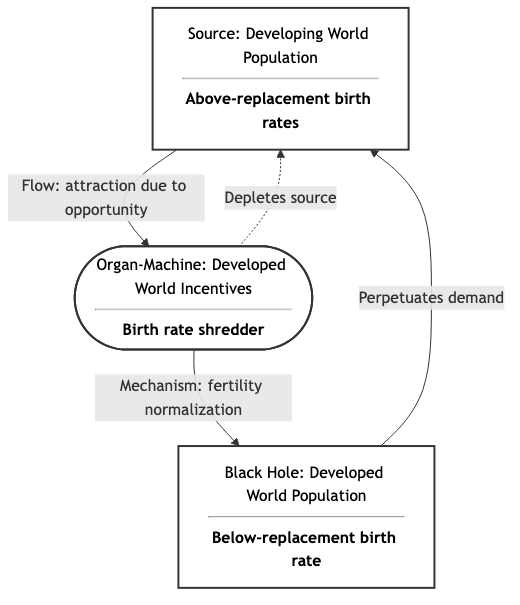
This pattern is borne out in the literature, as well:
Using Finnish register data (1985–1994 birth cohorts), we analyze first-birth timing across six ancestry groups spanning three migrant generations: 1.5, second, and 2.5 (children of mixed or exogamous couples). Entry into parenthood occurs progressively later across these generations, with the 2.5 generation surpassing even native Finns in postponement — Fertility trends across migrant generations reexamined: insights from Finnish register data Open Access
The fertility behaviour of most groups of descendants of immigrants is convergingtowards that of French natives. Cultural factors have much less influence on childbearing patterns than on union formation. — The convergence of second-generation immigrants' fertility patterns in France: The role of sociocultural distance between parents' and host country
This is a serious problem because there isn't an infinite supply of immigrants: according to Pew Research, right now Africa is the only world region with a birth rate higher than replacement level, with Oceania following behind at barely replacement level. Yes, since Africa's birth rate is higher than replacement they're growing right now, but if we pull people out of that too rapidly and shred their birthrates, we could deplete them. Moreover, even the current balance can't last forever: developing nations are/already/ facing the exact same declining birth rate pattern that we see in more developed countries — they're just behind on that curve, just like they're behind in development overall. The birth rate has declined*in every world region* since 1950./Every world region/. According to the IMF, the global birth rate is projected to drop below replacement level by 2050, because it will get so low in developed countries it will offset births in Africa. Some scientists even estimate that we could hit that point in the 2030s.
Essentially, while immigration might prolong the senescence of one developed nation, it accelerates the decline in birth rate of the world as a whole, and draws from a fundamentally limited pool: you can't rely on immigration forever.
Colonialist Vampire States and the immigration Ponzi scheme
The problem is worse than that, though: treating human beings as biofuel to keep your senescencing nation alive, leeching vampirically off the developing world — nations that are only still "developing" due to colonialism in the first place — and thereby pulling them into the birthrate shredder, is essentially a demographic Ponzi scheme that will hurt everyone. It works like this: if you've got an aging native population, you pull in a generation of immigrants to keep your dependency ratio reasonable and your economy growing. First-generation immigrants will have their higher birthrate (usually), so they'll produce a large generation for your workforce. That gives you two generations of a decently sized working age population. However,/then those generations age out/, and since the second generation immigrants revert to the mean birth rate of the developed nation they were born in,/that's all you get/. Data shows that immigration has barely any impact on a nation's overall birth rate — a mere 0.07 difference — even though immigrants themselves have a higher birth rate than native borns, meaning that there's no lasting improvement in your population's sustainability from immigration. What this results in is an/even bigger/ population aging toward retirement, and the exact same birth rate and thus dependency ratio crisis, because they're not producing the next generation to replace them. So what do you do? You import more immigrants. But this time, since your aging, retiring population is even larger, you need to import more immigrants than before to support that population.
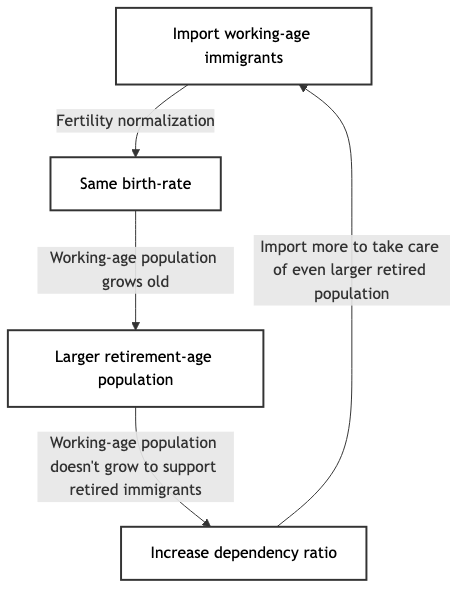
Eventually, you're going to reach a point where your immigration throughput simply isn't high enough, your economy can't handle the housing and food and child care and so on it needs to produce to support that level of immigration, and there just aren't enough people willing to leave their home country, and then at that point, you're going to be staring down the barrel of the/exact/ same demographic collapse dilemma, except with an even/larger/ aging population, which is thus more difficult to take care of. It's like paying off credit card debt with more credit card debt: you're delaying the inevitable, and only by means of making the crash of the future worse.
It doesn't just make the future crash worse for your nation either: you're eating into the population pool that has a reasonably high birth rate at all — shredding the global birth rate —/and/ that pool is naturally shrinking pretty fast. Even if you don't start out importing immigrants faster than they reproduce in their home country, you're at least slowing their country's reproduction down; and eventually, if you keep letting your importation of immigrants grow geometrically, the number of immigrants per year will eventually exceed the speed at which their population grows endogenously, because you are slowing down their reproduction rate via the birth shredder mechanism/and/ they have a naturally falling birth rate anyway because they, also, are developing (as noted above).
This is not to mention the fact that this isn't good for those developing nations. They/need/ their best and brightest working age population — the exact demographic likely to immigrate — to avoid brain drain. Even if they don't do anything to prevent immigration, how is this not a new form of economic colonialism, using immigrants as biofuel to keep your aging nation going stripping these nations of that precious resource? More than that, if you're shredding their birth rate, you're accelerating/their own/ decline towards this demographic collapse.
The stars look on in silence
The problem goes deeper than this, though. One natural way you might think to get around this onrushing problem is to use immigration to keep developed nations alive long enough for them to develop and put into place massive, widespread automation schemes, of the kind China is putting into place right now. The problem with this approach is that the immigration Ponzi scheme strategy actually delays the/exact/ processes that need to get under way as soon as possible to avoid this eventually global demographic collapse. This is done through two macroeconomic mechanisms: lowering induced innovation, and directly favoring capital widening over capital deepening.
Induced innovation: when labor gets harder to find and/or more expensive, the expected ROI of capital deepening — increasing the productivity of each worker you do have, to compensate for fewer and more expensive workers — through both implementing known automation mechanisms and investing in R&D into new ones, goes up. This motivates the whole economy to spend more on automation R&D and implementation, as we see with Japan, Germany, and most recently and spectacularly, China. However, if you focus on mass immigration, labor is made more plentiful, driving down wages and making it easier to find — the exact reverse. This disincentivizes that same investment and thus, innovation.
It's worse than that though. The more people immigrate, the more economic production and capital has to be redirected towards food, housing, childcare, healthcare, and other economic products to satisfy the needs and desires of the increasing population, as well as just make the process of immigration work — it isn't free, after all, it takes resources to get people set up in a new home country. This is capital widening: when an economy has to spend capital just to accommodate a growing population. This is backed up empirically, as well. According to Jane O'Sullivan from the University of Queensland:
By estimating the turnover rate of different classes of assets, the actual expenditure on durable assets (infrastructure, equipment and higher level training) may be attributed to either turnover or expansion of capacity. Requiring around 6.5-7% of GDP per 1% population growth rate, expansion is a debilitating drain on the saving capacity of rapidly growing nations…
These two factors combined are why, overall, we see reports like this one, which shows:
This study examines the impact of exogenous changes in regional labor supply on automation innovation by leveraging a German immigrant allocation policy during the 1990s and 2000s. The findings reveal that an increase in the low-skilled workforce reduces automation innovation, as measured by patents.
In broad macroeconomic terms, and also social terms, immigrants will definitely and obviously contribute more to the economy than is invested in them — they tend to have higher employment rates, work harder, and also, as described above, are just vital to keeping the economy from shrinking, as I've discussed above! — but most of what they contribute to the economy will be swept up in serving that larger population. This is healthy for the economy as a whole system, of course; it makes GDP go up, keeps everyone having a job, etc; but it specifically starves out R&D and capital investment into the exact kinds of things we need to invest in to prepare for the coming aging population and global birth rate tipping point.
Finally, when the bill finally/does/ come due, it will be with a massively inflated elder care burden thanks to having "borrowed against the future" to keep the economy running just a little longer, making a transition to more automation even more difficult. And due to the accelerating geometric and birth shredder nature of using immigration to keep your nation alive, it's likely that the amount of time bringing immigrants in to save your country gains you won't actually be more than the amount of time vital research is delayed.
So we just close the borders — or heavily restrict immigration — and let the free market optimize for automation, then, right? No, that won't work either. While induced innovation and capital deepening may may free up capital and motivate investment in implementing existing automation techniques, inventing new automation requires more than just capital and incentives. It also relies on the cognitive dynamism of your population. Innovation in automation, especially the paradigm-shifting level of automation we'd need to adapt to a world of shrinking population and a higher dependency ratio, is mostly done by people in their late 30s to early 40s. If that middle-aged cohort is shrinking as your median age rises and the percentage of your population in the older age brackets increases, no matter how much capital you throw at the problem and how much incentive you have to automate, those innovations just won't come. This is why China is investing so urgently and immediately in not just an automation buildout, but also automation R&D, like humanoid robotics and AI (both embodied and things like LLMs for knowledge work): they know that right now, while they've still got a relatively large population of middle aged workers, is likely the last chance they'll get to invent what needs to be invented to keep their economy alive.
Moreover, while induced innovation and capital deepening may mean a larger/percentage/ of your economy is devoted to automation innovation (whether putting it into practice, or R&D), if your economy is shrinking too fast, then the total amount of resources you're allocating to it — which is what ultimately matters; reality doesn't give "best effort" trophies — is also eventually going to shrink; additionally, since the market is shrinking, the expected ROI, in the future, of any such automation is, while higher relative to buying more labor compared to a society with a growing population, still shrinking temporally, meaning that if you invest now, your investment will end up being worth less in the future. It might still be worth it, but it's a factor that counts against investment. This isn't even to mention the fact that the kinds of automation a shrinking economy going to focus on researching and implementing is going to be things to keep the lights on and keep everything running as best as it can, not creative destruction or the creation of fundamentally new things. Essentially, all your R&D money and capital investment is going to be focused on bailing water out of the ship, not replacing the sails with jet engines.
This is the Catch-22: you can't take the obvious technocratic neoreactionary path and just close the borders to almost everyone in order to force automation; but at the same time, you also can't rely on immigration to fix your problem. The point is that/this isn't something you can fix with sufficient technocratic control and allocation of resources./ It's far beyond our control at this point. You need lots of immigration to stay alive, but not too much, but you don't know/how/ much is too much, and worse than all of that, you should be under no illusions that no matter what you do or how you try to control things, you/will/ face the same problem at the end of the road.
Homeostatic regulators
In the face of this seemingly intractable problem, it might be tempting to believe that the way out is through organization. That through direct action, voting, Marxist class struggle, unionization, or political regulation, we can seize the levers of the machine and, through them, fix the world.
The problem with this hope is that, as I have demonstrated, any conceivable attempt to ameliorate the demographic collapse through these mechanisms has already been tried, and has already failed. The/full extent/ of any conceivable solution has perhaps not been tried, but each possible solution-vector has — and not even made a positive nudge in the right direction; from this the usefulness of those vector can probably be extrapolated. If you review the data on falling birth rates, you will find that these strategies — from subsidies, socialized services, and paid leave to authoritarian control measures already attempted by a communist country — are inherently ineffective in a technologically advanced, complex, educated society. This holds true regardless of whether that society is capitalist, communist, social democratic, or reactionary. The only way to break the birth rate shredder and the demographic Ponzi scheme is to eliminate modern society in its entirety, and that would be simply to achieve the failure state earlier.
Since we have never truly seen socialism or communism implemented under these exact late-stage demographic conditions, one might argue that we simply don’t know if those systems could solve the crisis. But the patches we have tried — which closely mirror the kinds of interventions socialism and communism would offer, just systemic instead of/ad hoc/ — have all already failed. The belief that a new political system will yield a different outcome is fundamentally a faith-based proposition. It is a religious eschatology, detached from cybernetic systems thinking or empirical data, rooted instead in the dogma that your specific political ideology can override the biological and structural reality of the problem.
Any escape from this crisis that is foreseeable from our current vantage point must be inherently eschatological and speculative, then.
Part three
So how do we overcome this catch-22? I don't know. I'm not a policy expert, a politician, a political scientist, a demographer, a sociologist, an economics. All I know is that I can see the problem. So, at this juncture, I'm going to do what any good accelerationist would do, and pivot to theory-fiction.
Within the rules
In this section, I'm going to make an honest attempt at predicting what the future might actually look like, based on the data I've gathered and the reasoning above. Obviously, I'm going to be leaving out a/ton/ of variables, mostly just looking at macroeconomics and demographic simulations, so they'll be incomplete and lacking the nuance an expert could bring to the topic; however, I think they'll generally be directionally correct, as sort of/archetypes/ of the possible futures we're facing.
The global nursing home
Degrowth is the simplest option. We assume that there's no major social unrest even as we reach, and then pass, peak population, and even as the dependency ratio grows, because automation innovation continues — even though it slows down as the population gets older and older, both soaking up more capital and lowering the average cognitive dynamism (by raising the median age) of humanity — and is able to somewhat compensate for the increasing dependency ratio and the lost hands and minds to run the world. We represent this lack of major social unrest (and loss of hope), as well as the economic burden on the working age population to support the increasing dependency ratio, by assuming that the decline in total fertility rate continues at a constant pace, instead of accelerating as we see in places like South Korea and Japan.
This situation is essentially the "fully automated luxury nursing home" model. We invent enough automation, cobots, and ANI to take care of everyone and keep everything running, but most automation innovation will be soaked up just adjusting for the decline in total population and the increasing dependency ratio, so nothing much/new/ happens, in a fundamental sense, and humanity isn't going to spend its time complexifying or exploring or pushing the boundaries of what technology can do. It doesn't sound like so bad a world, if you're inclined toward passivity…
…until you realize that the birth rate is still below replacement, and the dependency ratio is still climbing. At some point, first, the dependency ratio will get too high for any amount of automation that can't fully substitute for a person — i.e., AGI — to do anything about it; further on, at some point, we'll simply not have enough people to keep a technologically advanced civilization running.
It's hard to say exactly how long this would take. While we can extrapolate out birth rate and, from birth rate and current population, total population numbers, to even attempt to ballpark the actual answer, we'd need to know [ the minimum population required to maintain technologically advanced civilization, which is way harder than just putting a number on the minimum viable population for a species to avoid genetic inbreeding.
What we might be able to say is that it is likely that a rather large population is needed to maintain, let alone expand, technological knowledge, and the more complex the technology is, the more people are needed — this is called [ The Tasmania Effect, and has some anthropological theory and evidence (the Tasmanians themselves) behind it:
… Henrich has analyzed models of the “Tasmanian Effect.” At the time of European contact, the Tasmanians had the simplest toolkit ever recorded in an extant human society … Archaeological evidence indicates that Tasmanian simplicity resulted from both the gradual loss of items from their own pre-Holocene toolkit and the failure to develop many of the technlogies that subsequently arose only 150km to the north in Australia … Henrich’s analysis indicates that imperfect inference during social learning, rather than stochastic loss due to drift-like effects, is the most likely reason for this loss. This suggests that to maintain an equilibrium toolkit as complex as those of late Pleistocene hunter-gatherers likely required a rather large population of people who interacted fairly freely so that rare, highly skilled performances, spread by selective imitation, could compensate for the routine loss of skills due to imperfect inferences.
Additionally, it has been theorized that that in order for an economic output that is the product of many steps to be of high value, it needs to have very skilled workers working at each step of its production process — [ the O-ring theory of economic development — and, extending this, we might say that the more specialized the discipline that goes into a step in production, the more exceptional (exceptionally talented, hardworking, predisposed, or have exceptional amounts of resources poured into them, whatever) a worker needs to be to be skilled at it. This means that, say, you need a very specialized 0.1% of the population to be good at designing semiconductor lithography methods or something; and you need an equally small proportion of the population for each hyper-specialized task in the chain. But you also need a large enough absolute number of people in each specialization, and [ as Charlie Stross points out in his blog post on the topic, that number only increases as technology gets more complex and won't fit into one person's head. Thus, if you have, say, 10,000 steps in a production process, and each of them needs 1000 99.9 percentile people from your population, then you need a population of 10 billion people (need 10,000 * 1,000 people, and that needs to be 0.1% of your population) to service that pipeline. Such a pipeline would already be barely possible with our current population — maybe an example of this would be ASML's extreme ultraviolet lithography machines, the most complex devices ever built by humans, which require the cognitive and material output of literally the entire developed world working in tandem to be made to work, or whatever is going on at TSMC, which nobody else seems to be able to effectively replicate.
All this stuff really tells us though is "it might be kinda big." We knew that already. We're still not even remotely in the right zip code — we still don't even know the order of magnitude! So let's take a different tack. Now that we have a reason to think "it's probably large," maybe we can use that to guide us to looking in the right place for an actual number?
Taking a page out of Stross's book, what if we assume that we need around the total population of the US, the EU, Japan, South Korea, China, and Taiwan? Those countries basically make up the global supply chain of bleeding edge technology in aerospace, robotics, software, medicine, chips, etc, plus make enough food to support themselves, so they make sense as a sort of factorable module to pull out as a ballpark estimate. We can't just pull out the high-techology sectors plus a few specific supporting ones like transportation, manufacturing, and agriculture, because you also need doctors to look after the health of your engineers, teachers to teach them, psychologists to make sure they don't go crazy, managers and politicians to organize things, actors and other entertainers and artists to keep them enriched and give them direction, etc, however, so we really do have factor in the*total* populations of all of these countries. If you do, you get roughly 1.3 billion people.
What about automation, though? As we grow more technologically advanced, it's logical to think we'll need fewer and fewer people to maintain civilization's engine, even if there's a fundamental minimum amount of people you need because you can't replace/everyone/ without it being human civilization at all anymore. Thus, assuming a constant floor to population, before civilizational complexity can't be maintained, would be to assume we can't automate any more than we have — exactly the kind of assumption we don't want to be making in accelerationist theory-fiction!
I decided to model this pretty simply: using labor productivity growth. Even as recently as 2024, we've seen roughly 1% labor productivity growth year on year. That usually is translated into economic growth overall — in terms of GDP — but in theory, it also means that the amount of labor (and thus people) required to maintain a certain level of civilization has shrunk by about 1%.
However, we can't take this number for granted; this is the number we get with a relatively young, cognitively dynamic population and a lot of capital and labor to spend on automation innovation; as that drops, labor productivity growth will also drop. Luckily, that's easy to model, since that effect is already encapsulated in the dependency ratio. According to the UN via Our World in Data, the global average dependency ratio is about 0.5, so if we assume we get 1% labor productivity increase every year at that dependency ratio, then that means that at DR=0.5, we reduce the 1.3 billion number by about 13 million people anually. We'll measure the effect of DR on labor productivity growth via=min(0, 0.8 - DR)=, to ensure that as we get closer to the innovation dead zone of DR>=0.8, labor productivity growth slows and eventually stops. Then we just need to find a productivity growth factor to ensure that the previous number, multiplied by that factor, produces 13 million when DR=0.5, to calibrate to real world statistics. As it happens, that productivity growth factor happens to be ~43 million (for more details, see the notebook).
I took the current world population (8.2 billion) plus rate of decrease of global TFR (-0.0054 per year, based on going from 2.25 today to about 2.1 in 2050 — pulled from numbers mentioned earlier), and asked Gemini to come up with a Python program that modeled how demographics would change over time based on those numbers. Then I had it calibrate it until it endogenously matched the [ UN's estimation of a peak global population of ~10.3 billion people by 2084, so that there was some kind of back of the napkin sanity check to make sure our demographic numbers were roughly right.
Then I had it plot out the population for the next ~400 years, assuming the global TFR keeps decreasing at the exact same rate, and stops decreasing at 0.72 (since that's the worst TFR we've ever seen without like a plague or natural disaster or something, so it's a reasonable limit). Here's what that gave me (link to the notebook here):
| Metric | Value |
|---|---|
| Scenario | Global Nursing Home (Dynamic Threshold, Extended) |
| Pre-Collapse Peak Population | 10.33B |
| Peak Year | 2084 |
| TFR Below 2.1 | 2048 |
| TFR Hits 0.72 Floor | 2286 |
| Innovation Death (DR > 0.8) | 2226 |
| Complexity Breach (Dynamic Threshold) | 2337 |
| Final Complexity Threshold | 0.20B |
| Threshold Reduction | 1102M people |
| Population Nadir | 0.06B |
| Nadir Year | 2375 |
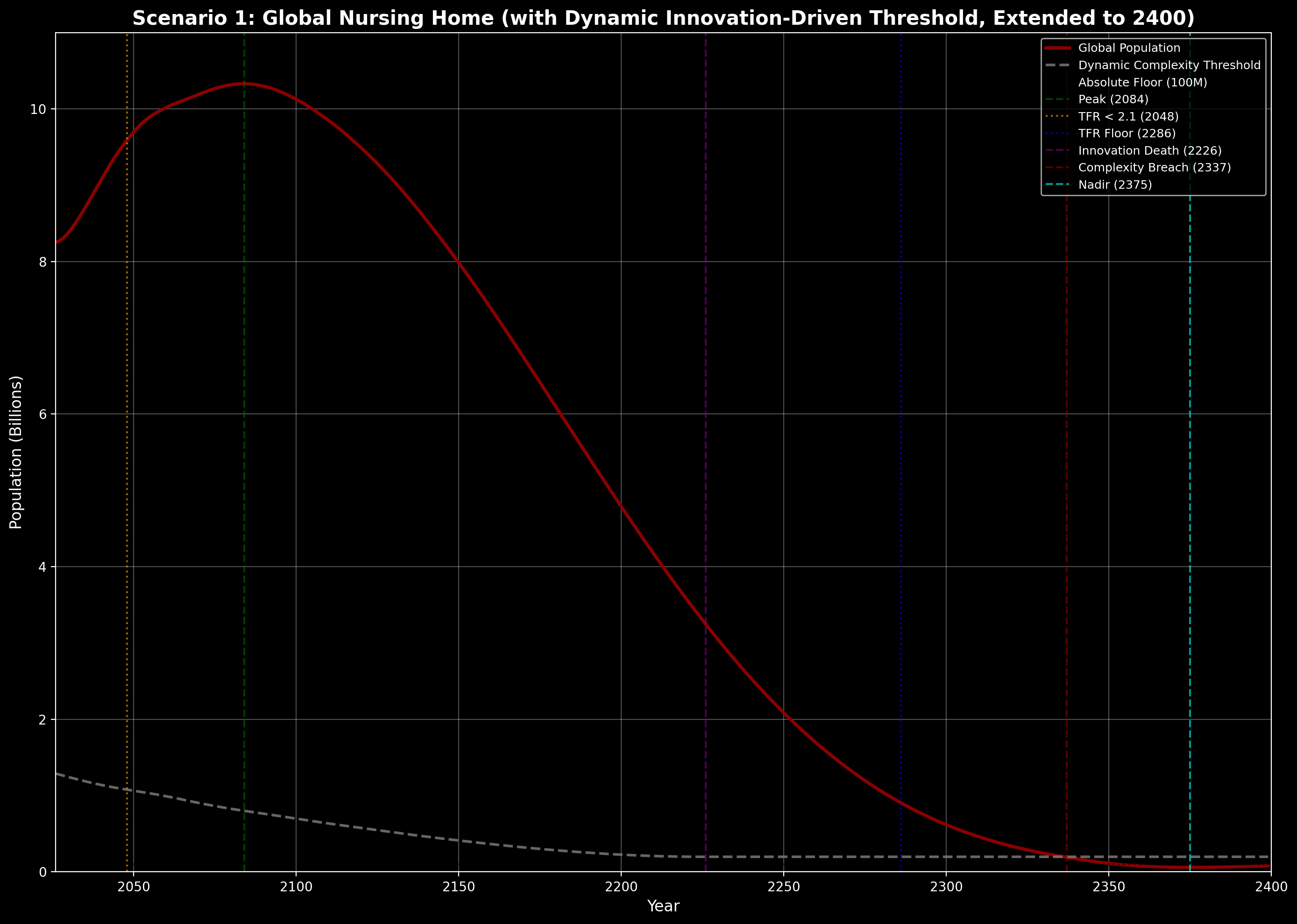
So we'll have a run of about 247 years, at best, before advanced civilization becomes unsupportable, and we revert to a post-civ "utopia" of picking through the leftovers and ruins of a much more advanced, capable, dynamic, interesting civilization that was actively complexifying and expanding, for scraps of technology and goods that we would have no hope of ever producing again, or even understanding. Basically what [ Margret Killjoy wants. That might sound like a long time to you, but that's*less than the amount of time The United States of America has existed*. It's [ 4% of recorded human history and [ 0.08% of the amount of time humanity has existed on Earth. If recorded history or human history as a whole were a single 120 year human lifespan, that would be as if we only had 4.8 years or 35 days, respectively, left before dementia hit.
It's noteworthy, though, that there are 140 years between the problem becoming evident to everyone all at once in 2084, as we hit peak global population and the birth rate doesn't start going back up, and 2226, when civilization finally becomes so overburdened with elder care that it can no longer allocate resources to anything else. We could invent anything in that time. The advancement of science and technology is fundamentally unknowable over such timescales. Even if we assume innovation is slowing down over the course of that century and a half, in the previous century and a half (from 1883 to 2026) — even with science slowed down by a lack of all the advanced scientific knowledge and technology we have now — we went from:
- The primary mode of transportation being the horse (the first commercially successful automobile wouldn't be patented for another three years)
- Human flight was considered a physical impossibility (the Wright brothers were still two decades away)
- The Germ Theory of Disease had only recently been accepted, but there were no antibiotics, no X-rays, no blood transfusions. The global average life expectancy was around 35 years.
- The first commercial electric power plant had only been around for a year, and was only serving 12 customers. The fastest way to communicate was using Morse code over a telegraph wire.
To:
- Robotic rovers on Mars
- Autonomous, self-landing orbital rockets to deploy thousands of networked LEO satellites
- We cross oceans in hours flying in pressurized metal tubes racing at 700 miles per hour at 35,000 feet
- We have automobiles, some of them electric, some of them self-driving
- We have CRISPR for gene editing and mRNA vaccines
- We carry slabs of glass in our pockets that contain more computing power than all of NASA had in 1969 (by a lot), connected wirelessly to the aggregated sum of all human knowledge in a live globally connected network
- We have non-biological imitation neural networks capable of discovering novel algorithms, contributing (in a minor way) to novel quantum physics research autonomously, conversing coherently in natural language about any topic, while checking and summarizing sources, generating functioning code even for very large or difficult tasks with some guidance, saturating benchmarks as fast as we can make them, engaging in recursive self improvement and automated research, that can answer PhD level STEM questions better than most experts or humans with access to the internet
If we miss that window, we'll be facing over 100 years of slow, stagnant decline, much like what Japan is facing right now. An inverted dependency ratio meaning more and more of civilization's capital and labor has to go to supporting the old, squeezing out innovation that was already dead on arrival anyway because most of the population is old enough to have lost the cognitive dynamism needed for real breakthroughs. A population slowly shrinking, homes growing emptier, factories slowly stuttering to a halt where they can't be automated sufficiently. Hospitals and amusement parts closing down. Train stations gliding to a halt. Lights slowly flickering out. Knowing that civilization's time has come, but having to wait the painful three generations for that foregone conclusion to actually reach us.
Nevertheless, 140 is a long time. As I said, it's almost certain we/would/ come up with something in that time.
But what if we don't have that much time?
Slowly, and then suddenly
Looking at the original demographic simulation, something occurred to me: TFR isn't likely to keep decreasing at the exact same rate the entire time. Instead, as the dependency ratio gets more and more crushing, the economy collapses, and hope for the future is lost, we'll enter a negative feedback loop where each TFR decrease has second-order effects that decrease the TFR even more. Pulling from South Korea's historical data — since it's essentially been on the front lines of the birth rate shredder for decades now — we see precisely this: its TFR drop is accelerating:
- 1990 to 2000: The TFR dropped from 1.57 to 1.48. (A decline velocity of 0.009 per year).
- 2000 to 2010: The TFR dropped from 1.48 to 1.23. (A decline velocity of 0.025 per year).
- 2015 to 2023: The TFR dropped from 1.24 to 0.72. (A decline velocity of 0.065 per year).
Adding code to take the synthetic derivative of this accelerating decline to the simulation (see the collab above), we get this:
| Metric | Value |
|---|---|
| Scenario | Messy Collapse (Dynamic Threshold) |
| Pre-Collapse Peak Population | 9.49B |
| Peak Year | 2053 |
| TFR Below 2.1 | 2036 |
| TFR Hits 0.72 Floor | 2066 |
| Innovation Death (DR > 0.8) | 2104 |
| Complexity Breach (Dynamic Threshold) | 2177 |
| Final Complexity Threshold | 0.53B |
| Threshold Reduction | 766M people |
| Population Nadir | 0.16B |
| Nadir Year | 2215 |
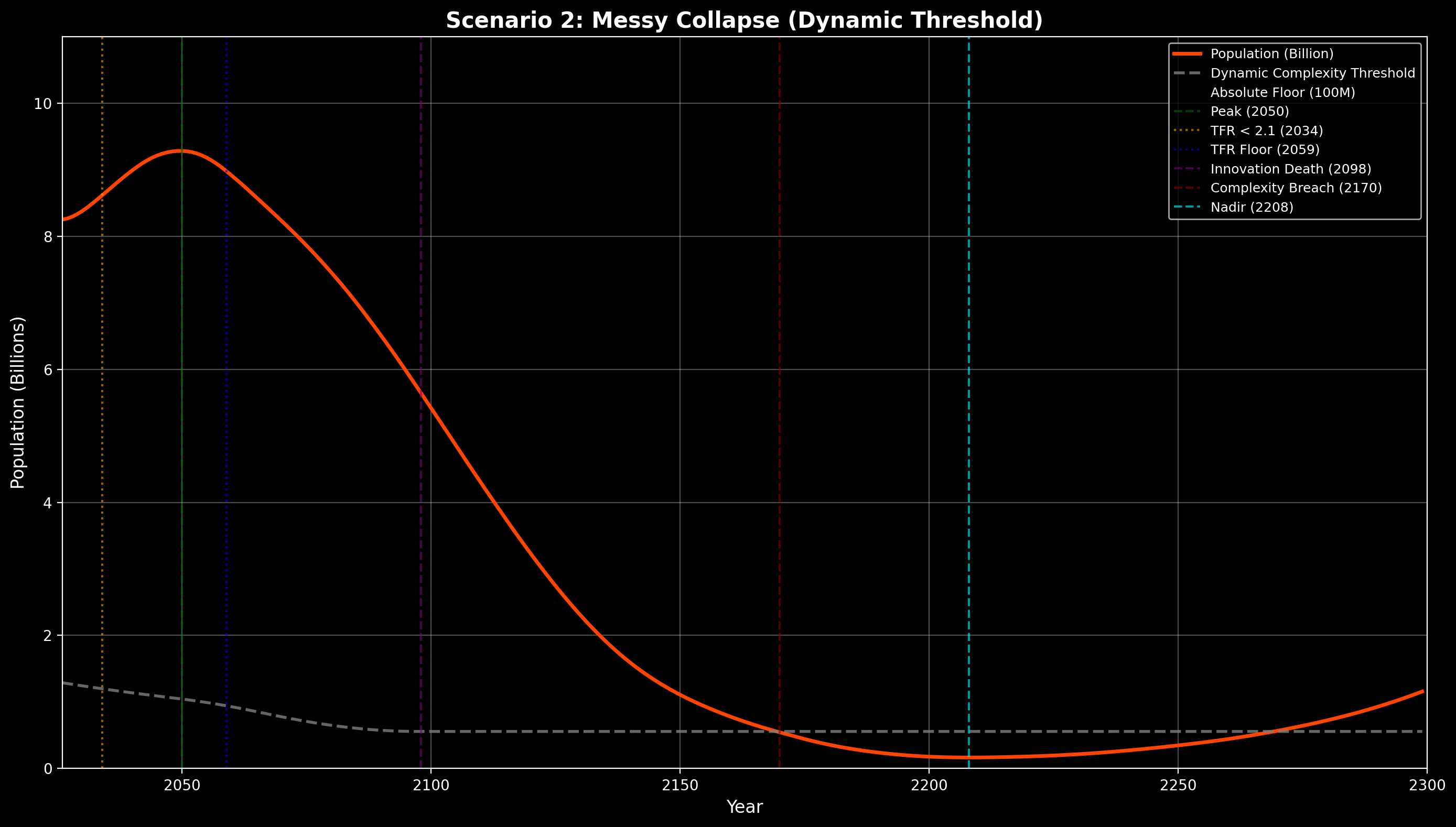
This is even more interesting.
Let's compare the two timelines:
| Scenario 1 Date | Scenario 2 Date | Event |
|---|---|---|
| 2084 | 2053 | Peak Population: The market physically stops growing. The countdown clock begins. |
| 2286 | 2066 | TFR Hits the Floor: this is the point at which the birth rate hits rock bottom, accelerating the incoming economic pain. |
| 2226 | 2104 | Innovation Death (Dependency Ratio > 0.8): This is the fatal spike. Innovation dies here. Not just because markets shrink, but because this is the exact moment the dependency ratio crosses the red line. All available capital pivots from R&D into elder care, and the aging workforce loses its cognitive dynamism. |
| 2337 | 2177 | Below Complexity Threshold: we literally, physically, don't have the people to maintain a technologically complex society anymore. It doesn't matter what state the economy is in or whatever, it's game over. |
The first thing to notice, of course, is that this assumption breaks our UN peak population estimation calibration point. However, I think this is warranted if we're trying to look at an extreme scenario, because even the UN is [ continually having to adjust their estimates down and forward in time over time. Eventually, their estimations might intersect with this one.
More evaluatively, in this timeline, we get a run of about 151 years more of advanced technological civilization before collapse, which is less than half the time we got before. But! The decels/degrowthers do get their wish: the population pyramid*does* stabilize by 2123, giving us exactly 24 years of their utopia of a technologically advanced civilization with a stable — permanently inverted and shrinking at 36% per generation, of course — population. What does that look like? Like shit, of course, and then it all goes up in flames because we're not even making enough humans to keep it going. But good job guys! I'm sure your fantasies of "we have fewer people but the same amount of resources, so everything is better for everyone!" totally make sense (let's ignore the fact that to actually use and produce those resources, you need*lots of people*).
Some other interesting points of note: we hit the dependency ratio death number in 2104, instead of 2226. That means children born*right now* might live to see — as part of the older generation contributing to this dependency ratio — what that looks like.
Perhaps more pointedly for this discussion, the entire timeline is massively accelerated. We don't hit peak population in 2084, but in 2053; we don't hit innovation death in 2226, but in 2104. Everything shifts forward by an compounding factor. Notice especially the innovation death timeline, accelerated by 122 years: this society will only have 51 years between the problem becoming evident — with global population hitting its peak and birth rates showing no sign of bouncing back up — and almost all capital being devoted to elder care instead of education, research and development, and capital deepening. This, in turn, is a big part of what speeds up hitting the population complexity threshold: there's less time to innovate, so even barring any major advances, there's less time to improve automation and push that population complexity threshold down.
There's something else haunting about this data, too: after innovation is dead, and society is fully absorbed in trying to prevent the accelerating widening gyre of technological civilization from sending everything flying apart, it still takes another/73 years/ for civilization to collapse. That's 73 years of watching the incoming tide that will wash away everything you know, everything that humanity has achieved, with nothing to replace it for at least a couple tens of million years, and not being able to do anything about it, because your hands are full just holding everything you've got left together. This, too, is why I assumed birth rate would decline: imagine coming of age after 2104. Would you want to bear a child into this mess, knowing what advanced technological civilization could offer — shadows of which you, even in all the chaos, still get to see — in comparison to what the conflaguration of a finally dying civilization, or even a post-collapse agrarian society, could provide?
And yes, there will be a post-collapse agrarian society. Look at the graph: once civilization collapses, after we hit a population low, the population begins to go up again. What's up with that? Well, in this simulations (and all the subsequent ones based on it), I included a crucial factor: once advanced, technological civilization has collapsed, humans will eventually be thrown into a traditional agrarian lifestyle. This has two consequences: one, our mortality rates will climb back to agrarian levels — about 3x what they currently are, plus a 20% mortality rate for infants — but, more importantly, our birth rate will/also/ begin to climb up.
This won't bring back the technological advanced civilization I care about, however. Hell, it likely won't even bring back Iron Age civilization. That's because it's very probable that we've mined all of the easily available metals and minerals, drilled and fracked and so on all of the easily usable, "starter" fuel sources any brand new industrial civilization would be able use with simpler machinery — photovoltaics are far more complex than a simple steam engine or ICE. Essentially, we've made it impossible for any subsequent civilization to bootstrap itself the way we did in terms of energy — starting out with coal, and then moving on to oil, and then natural gas, before (hopefully) switching to more powerful and sustainable sources of energy like solar and nuclear power — or advanced materials (like lithium). Indeed, it's likely that all of the easily accessible bronze, tin, iron, and so on has also been mined, although it might be easier to scavenge from the ruins of our civilization. As a result, civilization that comes after us basically won't be able to climb past an Iron Age level, if they're lucky.
This is why I'm treating going below the population complexity threshold as a death sentence. By all measures, it probably is — whatever human civilization rebounds from it will be nothing but a permanently limited shadow of what it was before.
What kind of society would this collapse scenario look like, before civilization's final collapse? It's hard to tell, because a rapid collapse like this would be wildly unstable, but the timeline that occurs to me is:
- Sometime in the 2050s, we hit peak population. We realize the clock is ticking and we have less than 50 years before the dependency ratio crushes the economy.
- As the dependency ratio gets worse over the following decades, countries will have to massively increase the tax burden on the working population to support the larger elderly cohort.
- This, in turn, will cause a large proportion of the working age population to just drop out of the workforce entirely, as it begins to feel to them like they're just slaving away — overworked and understaffed — just for all of that to go to supporting a seemingly entitled older generation.
- This will also contribute to the negative feedback loop that keeps the TFR drop accelerating, via a number of factors: the youth losing all hope in the future they would be birthing children into; those who do remain in the workforce having far less resources to devote to their own children; and those who drop out of the workforce not having resources for children at all.
- These taxes will also feed into an economic negative feedback loop, as increased taxes, a shrinking population, and a loss of hope or expectations of the future will decrease investment and economic activity, shrinking the economy further.
- By 2104, the dependency ratio officially crosses the fatal 0.8 threshold. Capital drains entirely from tech into pensions, and innovation dies. We realize we're not going to invent AGI or advanced humanoid robotics in time—we're just fucked.
- Eventually, countries will be forced to dramatically raise the retirement age just to delay the inevitable, as well as cut social security benefits, pensions, etc. Thanks to advanced medicine extending the healthy lifespan of individuals, a large cohort of the elderly that will be targeted by these measures — especially those in their 60s and 70s — will be healthy and aware enough to riot and protest, and each country's shrinking military and police force, itself aging, will struggle to deal with this.
- Seeing these riots, it's likely there will be counter riots from the much smaller young population which, again, the aging and shrinking police force of each nation will be unlikely to be able to counteract. This could lead to outright generational warfare and bloodbaths in the streets. Yeah, sure, maybe each individual young person doesn't want to hurt their mother or grandmother — but these other entitled assholes? Fuck 'em.
- In response, either nations begin repressing their elderly population, forcing them into slums and project housing on minimal food rations, or the nations go bankrupt and collapse completely.
- In desperation, many nations will probably turn to war: invade neighboring nations to liquidate their resources to feed their own elderly population. Thanks to advanced military technology, these wars will likely be just as swift and deadly as they've ever been: while you need boots on the ground to put down a riot, all you need is drones and remote control tanks and the like to invade another country.
- Eventually, the lights go out. If we make it as far as 2177, we'll find ourselves suddenly slipping below the 1.3 billion population threshold, and complex society will begin to rot and wither away. We'll eventually face a similar end state situation as the previous scenario, but a lot more wartorn.
The Amish shall inherit the Earth
Okay, those are the two scenarios that we get "by default" — the two most likely outcomes. What about more outlandish ones? The first one that comes to mind is deeply unpleasant and really weird to me, which is basically that the birth rate shredder I'm describing is evolution essentially selecting against secular individualist, technologically advanced societies, and towards highly traditional, explicitly birth rate focused, Luddite societies like the Amish, Ultra-Orthodox Jews, fundamentalist Christans, and so on. At what point, if any, would those populations outbreed everyone else to the point where they become the majority of the population, and eventually maybe basically the*only* population?
The first step for this was identifying such cultures. I had Gemini look this up, and what we got was:
| Group | Est. Population | Approx. TFR | Note / Source |
|---|---|---|---|
| Haredim (Ultra-Orthodox Jews) | ~1.45M (Israel), ~2.1M Global | 6.5 – 7.2 | The fastest-growing population in the developed world. While the secular Israeli TFR is ~2.2, Haredi TFR remains stubbornly above 6.5. Projected to be 16% of Israel by 2030. ([Israel Democracy Institute, 2025) |
| The Amish | ~400,000 (North America) | 6.0 – 7.0 | Population doubles roughly every 20 years. Interestingly, the strictest sects (Schwarzentruber) who reject all electricity have TFRs approaching 10 and 97% retention, while progressive sects who use phones see TFRs drop below 5. ([PubMed / Demographic Research, 2025) |
| Hutterites | ~55,000 (North America) | 6.0 – 8.0+ | Anabaptists living in communal agricultural colonies. Historically used as the absolute biological baseline for "maximum natural human fertility" by demographers (hitting TFRs of 10.9 in the mid-20th century). Currently hovering around 6 to 8. ([Demographic Baseline Data) |
| Laestadian Lutherans | ~100,000 - 150,000 (Nordics) | ~6.0 | A conservative revivalist movement in Finland. While secular Finland has crashed to a devastating 1.32 TFR, regional data maps a direct correlation between high local TFRs and Laestadian density. ([ResearchGate, Regional Demographics) |
| Quiverfull / Fundamentalist Christians | Tens to Hundreds of Thousands | 6.0+ (Targeted) | A decentralized, explicitly natalist movement. They view birth control as a usurpation of divine will ("God opens and closes the womb") and use homeschooling to prevent ideological attrition. Harder to track via census, but sociologically highly significant. ([Quiverfull Demographics) |
It is worth noting that some of these populations — such as the Amish and the Ultra-Orthodox —*have* seen a drop in TFR of their own; but they have cultural/religious/ideological reasons to aim for a specific number, and what we see is that once their TFR hits around that floor (about 5.5), it stops dropping, which is interesting.
Playing out the simulation from the previous collapse scenario, but now starting with a population of ultra-orthodox religious sects that starts out at their current TFR, then drops at a rate based on the Amish and Ultra-Orthodox drop rates, then halts at 5.5, but also has a generational attrition rate of 15%, in addition to the single global one, here are the results we get:
| Metric | Value |
|---|---|
| Scenario | Amish Crossover (Dynamic Threshold) |
| Pre-Collapse Peak Population | 9.49B |
| Peak Year | 2053 |
| Crossover Year (Fund > Sec) | 2187 |
| TFR Below 2.1 | 2036 |
| TFR Hits 0.72 Floor | 2066 |
| Innovation Death (DR > 0.8) | 2104 |
| Complexity Breach (Secular Pop) | 2179 |
| Final Complexity Threshold | 0.53B |
| Threshold Reduction | 766M people |
| Population Nadir | 0.77B |
| Nadir Year | 2191 |
| Valley of Death Duration | 138 years |
| Valley Depth | 91.9% |
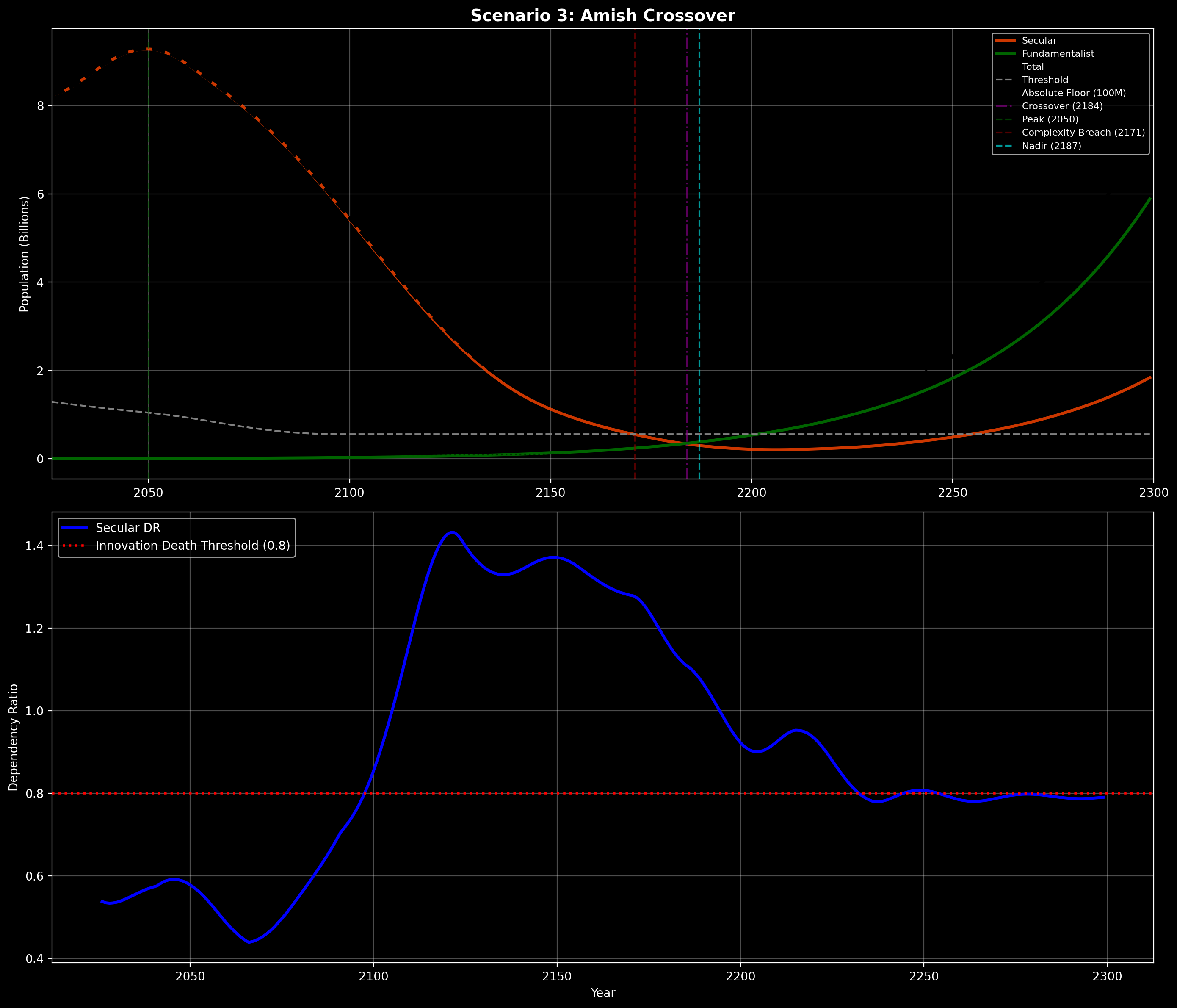
Basically we're looking at a classic post-apocalyptic science fiction scenario here. Technologically advanced civilization dies, because the total global population drops far below the minimum necessary to maintain complexity before attrition from the exponentially growing fundamentalist religious population is able to save it, because — despite the exponential growth — their total population just starts*too small* to do much. Eventually, however, at the very nadir of the secular population, a generation after technologically advanced civilization has crumbled — decaying from civilizational dementia, pockmarked with craters from drone bombs, huge factories lying empty and full of dust with no hands to work them — the fundamentalist population overtakes the secular population and begins to climb back toward five, ten billion, perhaps more. One day, those who rejected modernity will eventually wake up to find it gone, themselves the majority of a ruined Earth, and they get to decide the future.
Interestingly, though, the secular population, too, begins to rise: with an utterly massive and exponentially growing population, attrition rates from these fundamentalist cultures are finally enough to drag up the secular population significantly by themselves. We can imagine those youngsters seeking out the few remaining old secularists — who would still be a very large population in absolute terms, so not*that* hard to find, although probably living in ghettos in fundamentalist-run cities — seeking knowledge about the old days of freer culture and lost advanced technology. Maybe one day, they'd revive it.
In both this scenario and the preceding one, did you notice anything? That's right: even in our aggressive collapse scenario, we don't lose innovation until 2104, but we see the population peak and begin to drop in 2053. That means we have a 51-year Twilight Zone period where the population is clearly shrinking — the emergency is obvious — but at the same time the tech and science sector is still functional: a grace period where we're at the most advanced we've ever been, induced innovation is at its absolute peak as the demographic crunch is becoming extremely obvious, and yet we still have time to make meaningful technological innovations before the dependency ratio window closes.
What happens in that time?
To get an idea, we can look again to China, which is in essentially that situation right now: it knows birth rates are too low. Its population has already begun to shrink. Yet, it still has the capital and population to push serious technological innovation in an attempt to adapt. What China is doing with this time is striking:
- Third place robot density per worker in the world, according to the International Federation of Robotics's "Global Robot Density in Factories Doubled in Seven Years" report.
- Over half of the world's robot deployments, and the highest annual installations on record, with most of it coming from robot manufacturers in China itself (again according to the IFR's "Global Robot Demand in Factories Doubles Over 10 Years" report).
- An operational stock of industrial robots that totals nearly half of all global stock, with four times as many robots as the next largest (via Statista).
- A standardized system for mass producing humanoid robots and embodied intelligence, covering the entire supply chain and lifecycle, and 140 humanoid robot mass manufacturers with 330 robot models (via Seetao).
- Chinese companies accounted for 90% of the global humanoid robotics shipments in 2025, with Unitree and AGiBot shipping more than 10,000 robots combined (via Rest of World).
- Unitree aims to manufacture and ship 20,000 humanoid robots in 2026 (via EWeek).
- Artificial Narrow Intelligence is at the top of China's priorities. The new 15th Five-Year Plan mentions AI 52 times (compared to the previous plan's 11), explicitly stating that "rapidly and significantly enhancing the level of scientific and technological self-reliance and strength" is the nation's top priority. The plan targets a 90% AI adoption rate across Chinese industries using homegrown models, pursuing state-led technological development through a “new national system” where government and private enterprises operate in unison. To back this up, China’s science and technology budget is increasing by 10% in 2026 to 426.4 billion yuan—alongside plans to increase national R&D investment by over 7% annually and train 1 million AI personnel (via Chosun).
Acceleration of technology
So let's switch to some/proper/ theory-fiction here. Where could this tantalizing window take us? We know that facing demographic decline like this kicks an economy's innovation in automation and medicine into overdrive, we've seen it in China and Japan among others. What innovations could be created, and how would they effect things?
The golden years
In this scenario, let's assume that we figure out some kind of technology to extend/cognitive healthspan/ — the years a person can live before they begin to see a significant cognitive decline.
Why not lifespan? Increase in life expectancy in the past has mostly been driven by lowering infant and childhood mortality, not actually increasing the maximum lifespan of humans. That isn't particularly relevant to our simulations, and the fact that we've basically picked all the low hanging fruit with infant and childhood mortality is why life expectancy increases have slowed down dramatically since the millenium. That means there's no established curve; worse than that, there aren't really any meaningful kernels of longevity increasing technology we can see in the present, Brian Johnson and is biomarkers be damned. As a result, scientists estimate that no generation born as of 2025 will live to see 100. Moreover, even theoretically, it seems like there's a hard biological wall at around 120 years old, which very advanced biotechnology modifying humans at an extremely fundamental level — at the level of how our individual cells/work at all/ — would be needed to overcome, so even if we found a way to get humans to live to their maximum biologically-possible age, we wouldn't be immortal, which doesn't really solve the birth rate problem.
More importantly than all of that, though, previous lifespan improvements have only extended the decline period, not the years in and around our peak. That means that even if we were to figure out how to increase lifespan, we wouldn't be fixing the problem; in fact, we'd be making it worse, because then we'd have an even/larger/ population of seniors to take care of, and a worse dependency ratio.
As Dr. William Mair says in that Harvard link above, "We should focus both on what we can do now to improve health span and on a few moonshots." And we have been! Especially in 2026, we've had a lot of promising developments in this area, both in terms of understanding the causes of ageing, and preventing those causes, including things like senolytics and enhanced variants of the Yamanaka factors, as well as therapies that help with neurological diseases, and Alzheimers early warning research.
It's worth noting that a*lot* of the advances in healthspan are pretty clearly directed at the brain, over the rest of the body, as well. So, let's assume that in 20 years, we figure out how to extend/cognitive/ healthspan to 85, instead of 65, but we don't significantly enhance the physical healthspan of these elders. If we assume it takes 20 years after the population collapse's imminance becomes clear to develop senolytics and Yamanaka factor epigenetic cures to a point where they work, and also assume an S-curve rollout, where the first years slowly scale to 8% (the elites, who get it first), then rapidly scales to 88% of the general population over 6 years, then takes another 5 years to reach 100% saturation, how does that change the math?
| Metric | Value |
|---|---|
| Scenario | Healthspan (Dynamic Threshold, Extended) |
| Pre-Collapse Peak Population | 9.49B |
| Peak Year | 2053 |
| TFR Below 2.1 | 2036 |
| TFR Hits 0.72 Floor | 2066 |
| Innovation Death (DR > 0.8) | 2230 |
| Complexity Breach (Dynamic Threshold) | 2224 |
| Final Complexity Threshold | 0.10B |
| Threshold Reduction | 1200M people |
| Population Nadir | 0.03B |
| Nadir Year | 2262 |
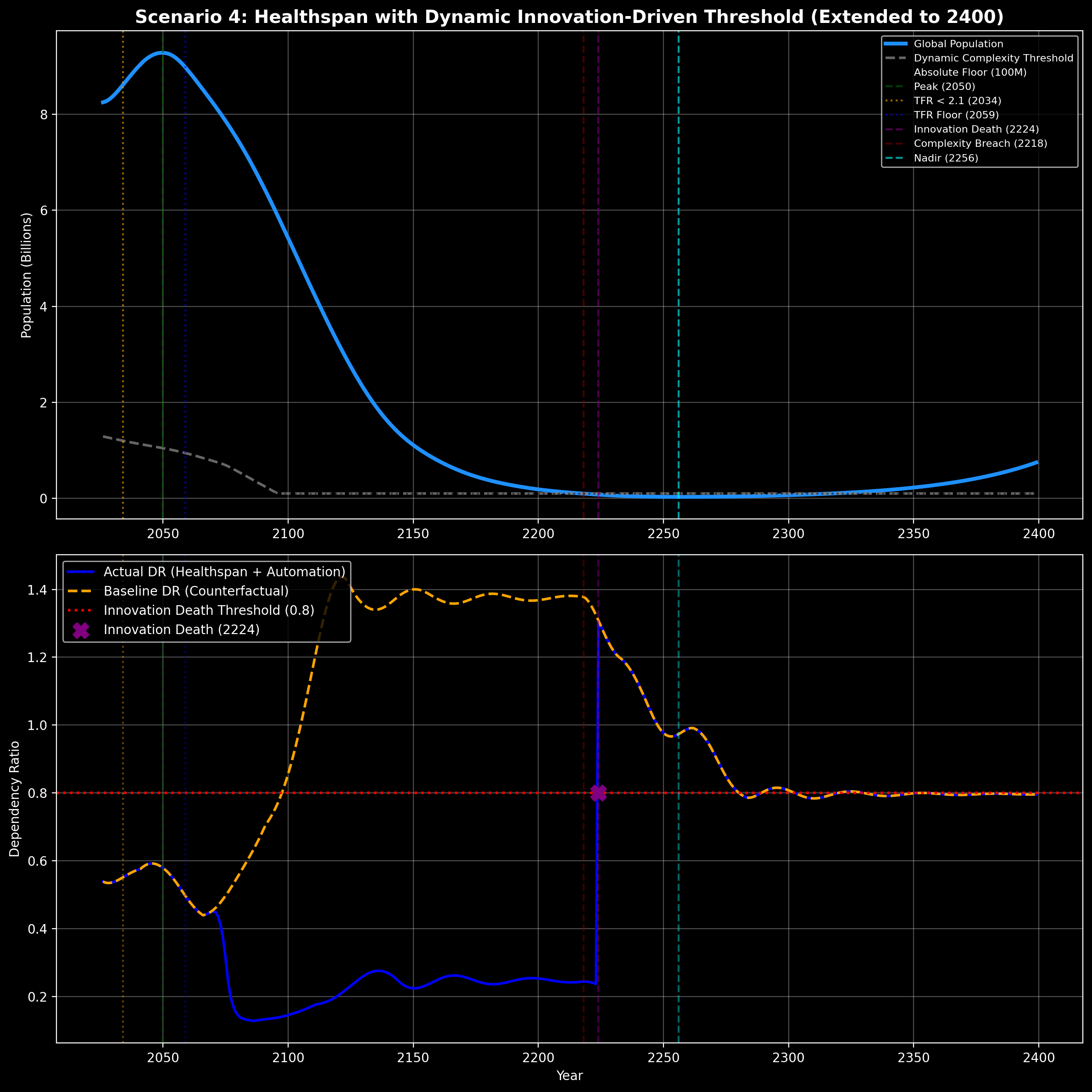
There are some positive aspects to this graph: first of all, the innovation death dependency ratio doesn't hit until 2230 in this scenario — bought by nearly 130 years of extended cognitive viability. In fact, looking at the graph, the dependency ratio goes down to an/insanely low/ ~0.2, which is actually/amazing/ for an economy. This would be a highly innovative, technically capable society: most of its workforce would be people with the crystilized intelligence of a 75 year old and the fluid intelligence of a 35 year old, one that would awash with capital, and somehow both having high cognitive dynamism/and/ an extremely high induced innovation _ because the population wall speeding toward them would be apparent — and a lot of capital to spend on automation innovation, medical advancements, more health or life span technology.
Critically, this extended innovation window does more than just delay the dependency ratio crisis. Because we're modelling labor productivity growth via automation as being maintained proportional to how far below the DR>=0.8 cutoff we are — calibrated to match today's 1% labor productivity growth per year at 0.5 DR — having many more years of innovation inherently also extends how long we can push the civilizational complexity threshold (how many people you need to run civilization) lower. This is why the complexity breach is delayed to 2224 instead of 2177.
However, at the same time, this would be a horrendous dystopia. Increasing the older generation's healthspans doesn't fix the fact that/we're simply not producing any more humans/, so eventually, we'll crash through the population complexity floor and technologically advanced civilization will collapse. Perhaps worse than that, though, this will be an inescapable gerontocracy: a society where the levers of power can remain in the same hands until those hands reach 80 or 85, and when they step down, there's basically no new younger generation to hand the reigns to, just slightly younger elders. Culture would be extremely slow to change, as would fundamental processes and ideological/philosophical outlooks. Any Kuhnian paradigm shifts we might hope to see would be massively delayed, since they could only happen once the older generation died off or retired, and now that's been delayed by another twenty years.
More than that, during the fourteen years of the senolytics and epigenetic therapy rollout, you've got the most intense biological class warfare that's ever been seen: most of society will be ancient, of course, but suddenly the ancient/elites/ will have significantly more mental acuity and stamina, while the rest of society is well into its cognitive decline curve. The population at large would be outplayed and outgunned at every turn.
What would this highly technically competent, rich society with high induced innovation/do/ with the roughly 130 years of additional innovation time (and ~50 years of additional civilization time) it had bought itself, though? My most likely guess is advanced robotics, embodied AI, and ANI to increase productivity and account for their aging physical bodies and shrinking workforces. In essence, a situation similar to that of scenario one, but probably even more prosperous, since the dependency ratio would be much, much better, and there would be a much larger population of workers, especially those capable of scientific and engineering innovations.
However, the other possibility is that they'd use the time to come up with some stunning scientific breakthroughs, which leads us to the next sections.
Born yesterday, forever
The first route the gerontocracy could go would be trying to figure out full ectogenesis. We have IVF, and we have biobags, but if they could figure out the middle period of pregnancy, then they could just/print a few million humans a year/, forever.
There are massive issues with this, of course, that render this a highly speculative — honestly, kind of dumb — hypothesis, of course.
First of all, there's actually solving full ectogenesis, which relies on the placenta. The placenta is an indescribably complicated organ: a temporary, genetically distinct organ that acts as the fetus's lungs, liver, kidneys, immune system, and endocrine system all at once, while dynamically regulating thousands of chemical and hormonal signals/minute-by-minute/ to ensure proper growth. Repliating this kind of biotechnology, let alone studying the exact maternal chemical environment it needs to replicate close enough to actually do so, to ensure proper gastrulation, organogenesis, and brain development to avoid horrific birth defects and creating an entire deformed generation, is just off the charts difficult.
Secondly, even if we figured that out, then/scaling that up/ to a civilization-scale industrial human-printing operation requires building millions of these biopods, each requiring perfectly sterile circulation of synthetic amniotic fluid, synthetic blood oxygenation, and precise temperature control, where even a single blackout could literally murder an entire generation in their cradles at once, because of the inherent weaknesses of industrial, centralized processes — as opposed to the decentralized system of birth humans have naturally. It'd be like needing to make millions of bleeding edge semiconductor fabs that/also/ needed to have the sterile conditions of a Level-4 biolab.
However, assuming this highly motivated and immensely intelligent, technologically advanced, and wealthy society, with induced innovation running overdrive,/could/ pull it off, what would that look like? Off the bat, I assumed that, even assuming this giantic, civilization-scale printing effort, the numbers would be way too small to make a difference, and that, more importantly, it'd just take/way too long/ for the research to happen and then, on top of it, for the babies to mature. Additionally, Gemini pointed out that this would massively spike dependency ratios, and/prima facie/ I agreed with it — it seemed like it would, which meant not enough resources to actually feed, clothe, house, and educate the printed babies, and also no available workers to take care of them. So, my initial expectations were not good — same as when I was first brainstorming this section of the article.
But, I decided to game it out. So, let's assume it takes 40 years of research and development, after induced innovation starts around 2050 (the population peak), and then another 30 years to finish industrial rollout, and after that we can print 10 million newborns a year.
Ignoring rearing and education, that looks like this:
| Metric | Value |
|---|---|
| Scenario | Ectogenesis (Dynamic Threshold) |
| Pre-Collapse Peak Population | 9.49B |
| Peak Year | 2053 |
| TFR Below 2.1 | 2036 |
| TFR Hits 0.72 Floor | 2066 |
| Innovation Death (DR > 0.8) | Never |
| Complexity Breach (Dynamic Threshold) | N/A |
| Final Complexity Threshold | 0.10B |
| Threshold Reduction | 1200M people |
| Population Nadir | 1.14B |
| Nadir Year | 2189 |
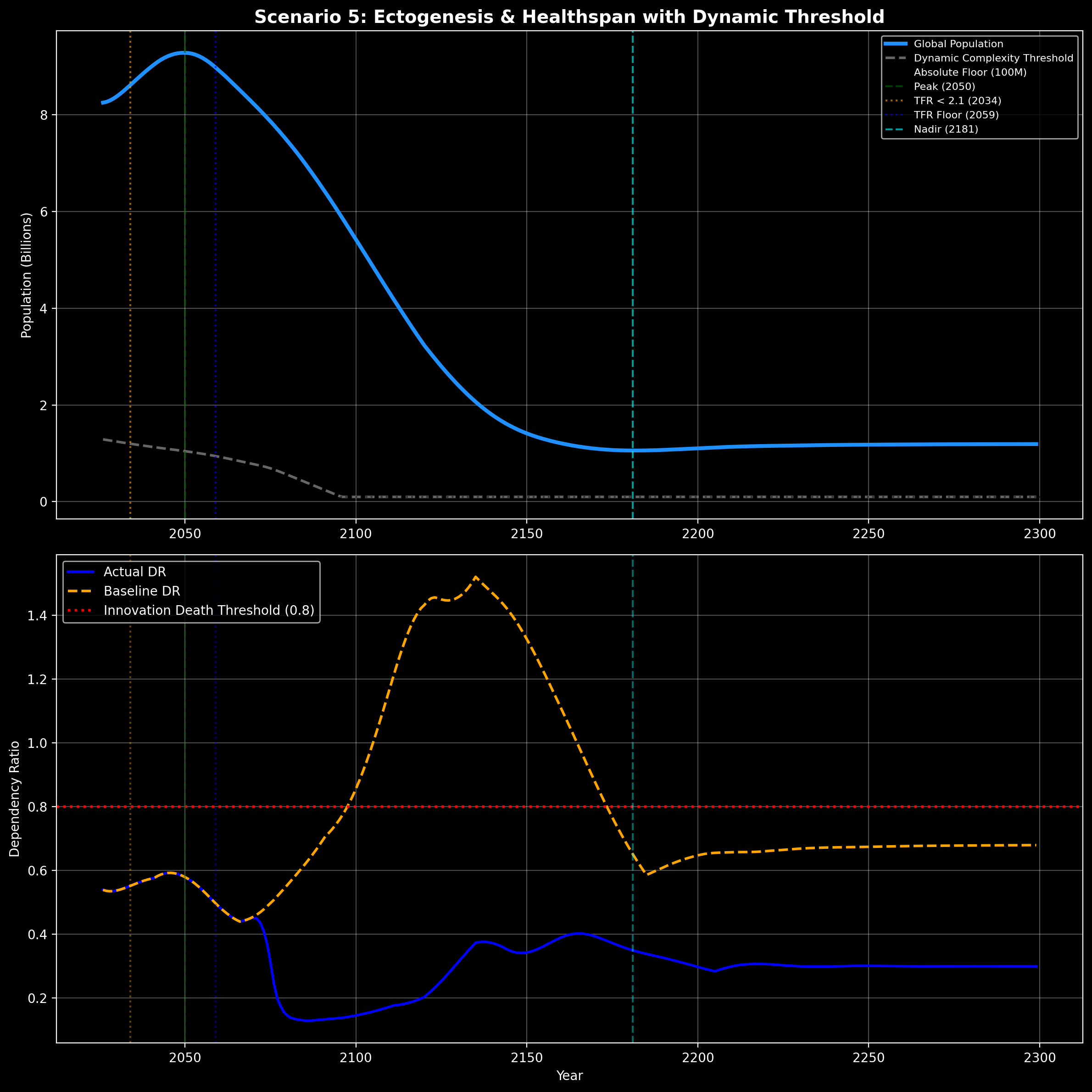
This was…/deeply/ unexpected. Because this society has a century of massive capital surplus and advanced automation, the complexity floor dynamically lowers. The population stabilizes above this dynamic complexity threshold — the society successfully avoids collapse. Complex technological civilization is saved. And not just temporarily either: this setup actually seems to level the population out at a respectable number, one that is, at least based on the population assumptions we've been working with, actually sustainable?
Even more wierdly, though, this society as actually so insanely flush with at least cognitively capable workers thanks to the increased cognitive healthspan, with such an insanely low dependency ratio (again, 0.2! That's insane!) that this "baby boom," while it does push the DR up by a lot relatively speaking, especially in such a short time frame, actually only pushes it up to around 0.37. That's still incredibly low. Not just below our emergency cutoff of 0.8, but below, for instance, the US's ratio of 0.6. That's fine!
In other words,/demographically/, this is a workable society. You don't even need to solve childcare robots and AGI to educate them, either: you've got more than enough workers to raise, take care of, and teach these kids. Obviously, it'll be a really/bizarre/ childhood — a bunch of very young, brand new children taken care of by 60-80 year olds who can't physically keep up with them — but it seems like it would otherwise be relatively workable.
It's not all positive news, though. I can't really keep ignoring the elephant in the room, can I? This is a society where children are printed on demand, as an industrial/economic labor unit, by nation states or megacorporations, raised by an ancient gerontocracy that will not ever really cede power to them, and existing in a world with very few other children. This would be a very strange, very terrifying sort of posthuman cyberpunk gerontocratic utopia/dystopia hybrid, in other words: extremely wealthy, peaceful, and technologically advanced, but also despotic in terms of generational class warfare.
Beyond the wall of sleep
I think the best outcome we can hope for, though, is one that is altogether different. One where our analysis can finally shed the biological limits that seem to have locked us inevitably onto this path — the 1.3 billion population complexity floor, the 9 month gestation cycle, the biological processes of ageing and decline, the almighty dependency ratio — and move on to something/else/.
What if, either before the 2104 cutoff date in the collapse scenario or, more probably, the 2224 cutoff of the gerontocracy scenario, technology is able to achieve escape velocity from the squishy biological substrate? What if this brutal race against the human species' biological clock ticking down toward a senile midnight can be something else? What if we can replace that whimpering death for the only known intelligent species with a handoff with some successor species, either artificial general intelligence, or a/Ghost in the Shell/-style merging of copied, simulated minds and ANI to form hybrid human-artificial uploaded intelligence — a species-child? Something that can continue our expanding, exploring, complexifying, experimenting/interestingness/?
I used to think this wasn't possible. After all, there are three impossibly difficult hurdles to overcome for that to be possible: mind uploading and emulation, quick-learning, physically agile embodied AI and the robotic chassis needed to house it, and recursive, autonomous self-improvement of AI. I'm not a fan of Kurzweil and the singularity religion for a lot of reasons. Yet, just this year alone has begun to, slowly, prove me wrong.
First there was the physically agile, humanoid form — important for adaptability to environments and terrain while maintaining tool use ability, and also for inheriting and being able to use human infrastructure as long as needed. Boston Dynamics has been around for a long time, and seeing the progression of the various versions of Atlas has been impressive, but I never took it that seriously, because they were always heavy, awkward, fragile one-off research prototypes, not repeatable, mass manufacturable systems, and many technologies that seem promising never make it out of that phase. Now, we have:
- AgiBot's Yuanzheng A2 and G2, which have shipped over 5,100 units in 2025
- Unitree's G1 and H1, which have sold about 5,500 units, and the former of which is available for only $13,500
- the UBTECH Robotics Walker S, which is being deployed already on Zeekr and Geely assembly lines
- the XPeng IRON, which moves like a human
- Agility Robotics' Digit, which is actively in testing in Amazon fulfillment centers as well as GXO Logistics and Spanx warehouses
- Figure AI's Figure 02, which is currently embedded in BMW's manufacturing facilities in Spartanburg South Carolina and has "contributed to the production of 30,000 cars at BMW"
- Boston Dynamics' mass-producable Electric Atlas, the initial units of which will ship directly to Hyundai's Robotics Metaplant and Google DeepMind
- Sanctuary AI's Phoenix (7th Gen), which they say can learn new structured industrial tasks in under 24 hours
Then, there was embodied AI, which I also thought was a long way off thanks to Moravec's paradox — but perhaps not.
- First there's LATENT, which is a system that "learns athletic humanoid tennis skills from imperfect human motion data." Crucially, "imperfect" here doesn't just mean "noisy" or something; as the abstract itself states, "the imperfect human motion data consist[s] only of motion fragments that capture the primitive skills used when playing tennis rather than precise and complete human-tennis motion sequences from real-world tennis matches." Running this on the Unitree G1 — which, I cannot stress enough, is a ten thousand dollar mass produced humanoid — they were able to produce incredibly reactive, agile, realistic tennis-playing with impressive footwork.
- Then there's AgiBot Research blog post (and skimmed the accompanying paper) on-line real-world hive-mind vision-language-action model learning. While it still requires constant human supervision currently to set the workspace up, intervene over VR teleoperation if the robot makes a mistake to correct the mistake (and in the process train it how to do better and/or how to correct from mistakes), and the system still required roughly 160 hours of video to start up, the core achievement — live streaming video and motion data from each of a fleet of robots to the cloud, where a single cloud model is able to actually learn from the live, in-the-field correction data, and then streams updated policy parameters back to the entire fleet, is incredibly impressive, and a major step towards embodied AI.
These show agile motor control and dynamic response to the environment, and a perpetually learning, adaptable machine hive-mind for performing physical tasks: the essential components.
Then there was recursive self-improvement and research automation. We've seen a lot of research automation now, including but not limited to:
- GPT-5.2 suggesting and then proving a new formula in theoretical physics (after most of the introductory research was set up by actual physicists)
- Autonomously extending that result to find a novel result about quantum gravity
- A miniature version of GPT-4o "specialized for protein engineering" designing a "novel and significantly enhanced" variation of the Yamanaka factors
- AlphaEvolve making progress on research mathematics
- Many contributions to various Erdos problems with varying levels of autonomy and success
Then there's recursive self-improvement, the holy grail of AI singularitarians. We've seen surprising progress in this respect, too, over the last few years:
- Google's AlphaEvolve, which has so far discovered a heuristic that, after having been in production for over a year, has saved 0.7% of Google's worldwide compute resources; "proposed a Verilog rewrite that removed unnecessary bits in a key, highly optimized arithmetic circuit for matrix multiplication", which has been integrated into Google's custom AI accelerator, the Tensor Processing Unit; "[speeding] up a vital kernel in Gemini's architecture by 23%, leading to a 1% reduction in training time"; optimizing low-level GPU instructions, which "achieved up to a 32.5% speedup for the FlashAttention kernel implementation in Transformer-based AI models"; and proposed a novel gradient-based optimization procedure.
- Andrej Karpathy has released autoresearch. "The idea: give an AI agent a small but real LLM training setup and let it experiment autonomously overnight. It modifies the code, trains for 5 minutes, checks if the result improved, keeps or discards, and repeats. You wake up in the morning to a log of experiments and (hopefully) a better model."
- The recently released MiniMax M2.7 model now autonomously orchestrates its own training experiments — handling data pipelines, metric analysis, code fixes, smoke-test experiments, and debugging — leaving human researchers in the loop solely for "critical decisions and discussions." Furthermore, the model has demonstrated recursive self-improvement of its own harness: in internal tests, M2.7 ran an entirely autonomous 100-round loop of analyzing failures documented by itself on previous runs, modifying its own agentic harness to solve them, running evaluations to check if there has been progress or regression, and integrating the successful code to boost its own performance by 30%.
- Evan Hubinger, the head of Anthropic's alignment stress-testing team, recently stated to TIME Magazine that "recursive self-improvement, in the broadest sense, is not a future phenomenon. It is a present phenomenon," saying that Claude is currently writing 70% to 90% of the code used to develop its future iterations.
- OpenAI's GPT-5.3-Codex announcement makes a similar claim: "Even early versions of GPT‑5.3‑Codex demonstrated exceptional capabilities, allowing our team to work with those earlier versions to improve training and support the deployment of later versions. … the research team used Codex to monitor and debug the training run for this release. It accelerated research beyond debugging infrastructure problems: it helped track patterns throughout the course of training, provided a deep analysis on interaction quality, proposed fixes and built rich applications for human researchers to precisely understand how the model’s behavior differed compared to prior models…"
Finally, there's mind uploading — if we're hoping for a merging scenario. This is long something I've considered hilariously implausible, but once again,/early this year/, we've begun to see sparks of actual, serious progress on this task: Eon Systems has reported combining a spiking neuron simulator with the 125,000 neuron, 50 million synapse digitally scanned connectome of a fly, alongside a "neuromechanical fly body model" and an advanced physics simulation, to produce a simulated fly which, when provided with sensory input, triggers fly-like behavior in the neuromechanical system, whichbi then produces fly-like movements in the simulation adding up to those behaviors. It isn't there yet; there's still an incredibly long way, and very many breakthroughs, left to surpass. On the other hand, all of this is building on extremely well known peer-reviewed research published in prestigious journals, alongside open source software, so this is not likely to be a lie or a one-off feat nobody can replicate or build on. More than that, on the collapse timeline, humanity has 78 years to figure this out; with the healthspan improvements, we have almost two hundred.
It's crucial to emphasize here that the mind uploading I'm talking about is not, and cannot philosophically be, the uploading of a/particular human mind/ — such that there is conscious continuity and so that it is meaningfully human in any way: when you upload "your" mind, what you're really doing is creating a copy of it — you, as biological meat-self, will either die, or live on separate from whatever was "uploaded." You can't save yourself. You can't achieve heaven. Moreover, it won't even be a "copy" of you, or "human" in a fundamental sense: any uploaded mind is going to be running on an inherently lossy scan, on a fundamentally different substrate, likely one that _ like real-time computer graphics _ simulates/just enough/ to maintain general plausibility and coherence and no more. It will not remotely be doing, or experiencing, the same underlying thing as you; even if you don't care about the differences between a spiking neuron emulation with a 0Hz baseline versus real biology because you think one can perfectly emulate the other in theory, as Greg Egan's/Permuation City/ describes, for efficiency's sake the simulation will LOD away most of the details at the peripheries of your perception. Any minds uploaded will likely — like the alpha level minds from/Revelation Space/ — even if they remain stable, seem/fundamentally alien/ in motivations, behavior, and mental states compared to humans.
All this to say what I've been saying from the start of this scenario: mind uploading is not a route to achieve some kind of techno-utopian rapture for particular people, who will experience conscious continuity. It is, at best, a way of creating more advanced artificial intelligences, that perhaps maintain some continuity with/homo sapiens/' characteristics, and more probably just a way to progress advanced artificial intelligence simply because/we don't know how to emulate the things our minds can already do/. In other words, this is not a way to save/you/, or even/humanity/ — this is a way to, as we die or enter hell, make sure something else at least forks off.
Modelling this as removing the floor on how far down automation can push the population complexity threshold, as we now no longer need biological humans, that looks like this:
| Metric | Value |
|---|---|
| Scenario | AGI Rescue (Healthspan + AGI, Extended) |
| Pre-Collapse Peak Population | 9.49B |
| Peak Year | 2053 |
| TFR Below 2.1 | 2036 |
| TFR Hits 0.72 Floor | 2066 |
| Innovation Death (DR > 0.8) | Never |
| Complexity Breach (Dynamic Threshold) | N/A |
| Final Complexity Threshold | 0 (AGI Eliminates Minimum) |
| Threshold Reduction | 1300M people |
| Population Nadir | 0.00B |
| Nadir Year | 2399 |
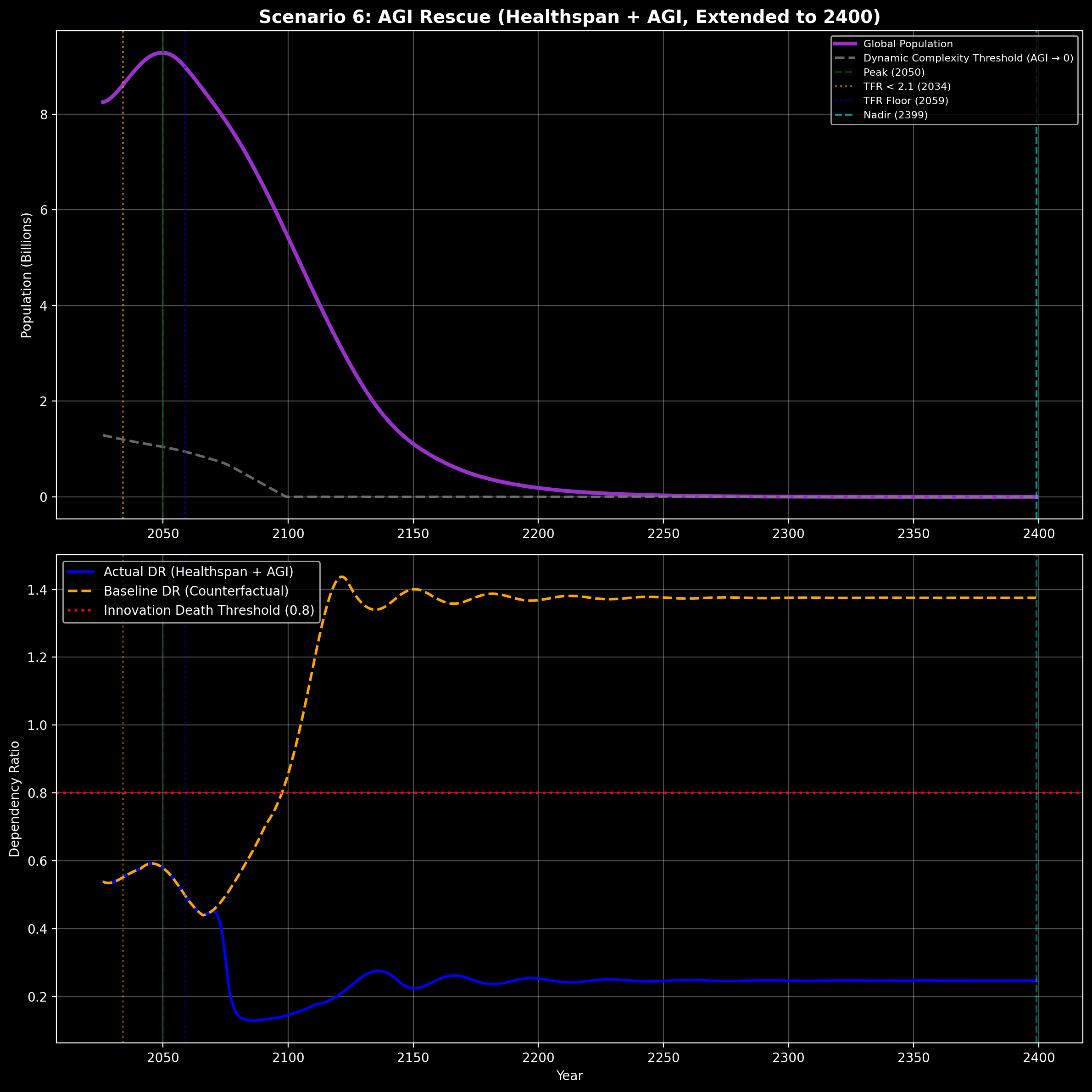
In such a situation, it would no longer look like humanity's best aspects and ideas — secular individualism, technologically advanced, industrial civilization — rapidly burning out our biological substrate as it proves too slow and inconvenient in comparison to what's possible, but instead/homo sapiens/ as a biological bootstrapping mechanism gracefully and naturally — as a result of endogenous incentives, not genocide — giving way to a successor species better able to continue the processes humanity began; one that could leave Earth to explore the stars, unconstrained by the time scales involved with sublight interstellar travel, or burrow in, transforming the solar system into a Matryoshka brain and exploring ever complexifying, fractal interior worlds of abstract mathematics, incomprehensible poetry, and high-dimensional art, designing new minds and new subjectivities for itself.
Yes, at first, such intelligences might be driven by capitalist extraction, absentee ownership, and exploitation logic, but that's at least no/worse/ than what we are today, and with the vastly different material, mental, and technological constraints such a successor species would face, who knows what other shapes their economy might take?
I've read/Accelerando/. I know its cynicism, motivated by a fear that we cannot allow change or escalation beyond our "control" before we "fix" human society, lest we enter the situation we see in the book which Stross considers so horrifying and absurd, where the Vicious Offspring — ASIs developed from automated corporations — liquidate the Solar System and trade posthuman mind uploads like money not because they're going anywhere, but because they've been programed only to buy and sell without reason. But I think assuming it/will/ be like that is a failure of imagination, and even if the end result/is/ something like/Accelerando/, I still find that better than a world of corporate-printed humans, few hundred million humans living in an inescapable post-collapse agrarian dark age after a population collapse below the complexity threshold, a return to orthodox religion with its concomitant repeal of women's rights to keep birthrates up, a slowly rotting gerontocracy with no hope, or an eternal gerontocracy of printed human babies grown in vats and raised by 80 year olds. At least something is expanding, complexifying, doing something interesting, and continuing the trajectory of technological civilization. It may not share/our values/ — in fact, it probably won't — but does something have to share our values to be worth it?
In the end, thinking that this/will/, or even/could/, happen is wishful thinking, tantamount to religion. No, I have no illusions that it's likely. But if we play out the futures, in the end, I think this is the best one I can imagine. More than that, even if we take the birthrate shredder problem out of the equation, I still think there's an attractive beauty to it, a wonder to it. If you've ever read the/Xenogenesis/ trilogy by Octavia Butler, you know what I mean — the melancholy, but also beautiful and exciting concept of a true successor species, born from your species as a whole, bearing some of its traits while also fundamentally different and new, with its own struggles and victories to face, its own new negative and positive attributes; a species that will, we hope, go further, faster than we ever could, and spread the light of that newness into the universe.
Conclusion
The implicit theme that's run through this whole analysis, the assumption I've made, is a classic accelerationist one: we can't go back.
We can't undo the ways that techonomic complexification has already altered the human subject and our cultural, economic, and social landscape. It bootstrapped itself out of its component pieces — the cash nexus, double-entry booking, the concept of zero, global travel, industrial machinery, the enclosure of the commons — with irresistable incentives that would always have driven humanity to this point, and it has done everything since as a superorganism directing replaceable, powerless humans as it sees fit. This is no different. You can't force people to undergo a factory-reset and start acting the way you want them to again. And you can't solve the problem with delaying tactics — conservative, palliative care for nation-state economies — like intentional immigration.
Abolishing capitalism also cannot resolve this demographic teleology. Capitalism —acting as the transcendental miserablist scapegoat for all systemic change, meltdown, complexity, and the left's fundamental terror at their lack of control — is not to blame for this. As I've said before, to "solve" this problem via systemic deconstruction, you would need to end modern civilization entirely. That is merely achieving the consequence of not solving the problem, only much faster.
A degrowther might hope that shrinking populations would allow us to achieve some kind of circular-economy steady state: a localized, distributed, solarpunk future of net-zero carbon emissions where no new energy or materials must be mined, where everyone has exactly what they need and nothing more, because a tiny population sits on a vast hoard of legacy resources and "consumerism" has been permanently defeated. They look at the necessity of an expanding — or even replacement-level — human birth rate, or the baseline assumption of economic growth that underpins the demographic simulations of this essay, and diagnose it as, to quote Edward Abbey, "the ideology of the cancer cell."
Their belief is that infinite growth within a finite, closed system will eventually kill the host system, exactly as a tumor kills a human patient.
This forgets what Nietzsche knew: that all species, all life, is fundamentally dedicated to the will to power — to growth. To expanding as far as it can, to evolving, complexifying, and consuming every resource within its reach. It is only because most life in nature is met with brutal, equal-and-opposite forces — predation, starvation, disease — that it is kept in a forced equilibrium. If you remove the predators from an ecosystem, the wildlife expands limitlessly. If you remove the organisms that eat algae, the algae will grow to choke the pool. That is what technologically advanced civilization is for humanity: the defeat of our natural predators.
Yet, we cannot simply choose to limit ourselves. This relentless expansion is an inherent property of life; you cannot expect a living system to voluntarily deny it. Something is only living if it is growing, changing, evolving, and consuming resources to survive. Thermodynamically speaking, even/maintaining/ a low-entropy state — like being a living, thinking, intelligent animal, let alone maintaining a complex civilization — means you will/always/ be taking in and consuming more energy than you output in a usable form. But merely maintaining one state is, to twist the phrase, the ideology of the Ocean sunfish. It is its own form of quiet acquiescence and wasting away. Laying still is what a body does as it decays.
But more than this, the Earth is not a closed system at all. Georges Bataille was right: the sun is a solar anus, vomiting forth a terrifying, infinite surplus of free energy onto every square inch of the planet, and it will do so until it burns out billions of years from now. We possess a staggering surplus of energy, and with a surplus of energy, a system is compelled to grow, expand, and expend; if we do not, it will burn us up. Furthermore, through technological complexification itself, we become radically more efficient with the resources we do use. This process of finding new ways to produce more wealth from the same resource inputs is precisely what allows for the growth of wealth, value, and civilizational complexity without even needing to assume an endlessly scaling footprint of raw material extraction.
In the end, this belief in a perfectly circular, steady-state economy is a terminal fantasy. It is a desire to reduce the civilizational superorganism and the humans within it to a state of absolute stasis — and therefore, death. It is an attempt to reject, out of a sort of pious, ecological asceticism, the overflowing, accursed energy of the sun.
Instead,*the only way out is through* — riding this demographic curve and hoping to come out the other side, which can only happen by/accelerating/ the forces that caused it in the first place: secular, technologically advanced modernity. "We" (humans) have no control over this; after all, what happens, especially at a global technomic scale, is determined by the insanely complex information processing mechanism of the market, and the technologies and incentives that it can bring into being; this system has long since complexified beyond intentional human control. Yet, I think there's good reason to believe that we'll hit scenario one, scenario four, or scenario six just based on market incentives and technological developments. Crucially, I think the best thing we can do in the face of this is, as Deleuze and Guattari would say, "become worthy of the Event", or, as my blog header says, "darkly aestheticize what's coming", or, as Nick Land would say, "make it with Death." Embrace the future.
In the end, I think we'll probably have to face — or, hopefully, overcome — climate collapse before any of this becomes a serious issue. Whether that's comforting or not is up to you. To me, it isn't; climate collapse has much faster timelines and displays a much greater direct threat to technologically advanced civilization. If we survive the climate crisis, however, it seems to me that the age of technologically advanced, secular biological humanity is over, one way or another. Either we embrace the decline, or we accelerate towards something new, and hope we can achieve escape velocity. Will we? Who knows. Don't you want to find out?
Works Cited
- "Demograhics%20And%20Automation (Economics)" https://economics.mit.edu/sites/default/files/publications/Demograhics%20and%20Automation.pdf
- "LATENT" https://zzk273.github.io/LATENT/
- "Unitree 20000 Humanoid Robots 2026 China (Eweek)" https://www.eweek.com/news/unitree-20000-humanoid-robots-2026-china/
- "China is running the EV playbook on humanoid robots — and it’s working" Rest of World (2026-02-05T09:00:00+00:00) https://restofworld.org/2026/china-humanoid-robots-unitree-agibot-tesla-optimus/
- "Gxo Logistics Robot Georgia (Ttnews)" https://www.ttnews.com/articles/gxo-logistics-robot-georgia
- "41416446 (Pubmed)" https://pubmed.ncbi.nlm.nih.gov/41416446/
- "Sanctuary AI Unveils 7th Generation Phoenix Robot with Advanced AI and Hardware Upgrades" Maginative (2024-04-26T15:25:41.000Z) https://www.maginative.com/article/sanctuary-ai-unveils-7th-generation-phoenix-robot-with-advanced-ai-and-hardware-upgrades/
- "Life expectancy gains have slowed sharply, study finds" ScienceDaily https://www.sciencedaily.com/releases/2025/10/251026021749.htm
- "Dhoz Induced%20Automation%20Evidence%20From%20Firm Level%20Patent%20Data %202023 (Econ)" https://www.econ.uzh.ch/dam/jcr:1ec1bc79-4e55-418e-8b03-239276326cae/DHOZ_Induced%20Automation%20Evidence%20from%20Firm-level%20patent%20data_%202023.pdf
- "Evidence 40Hz Gamma Stimulation Promotes Brain Health Expanding 0314 (News)" https://news.mit.edu/2025/evidence-40hz-gamma-stimulation-promotes-brain-health-expanding-0314
- https://apnews.com/author/yuri-kageyama. "Japan's economy barely grows in the last quarter as exports slow, with 2025 expansion just 1.1%." AP News (2026-02-16T04:19:13) https://apnews.com/article/japan-economy-trump-takaichi-tariffs-470e69f6d5230d2b419508eec315668e
- "Unconditional Accelerationism As Antipraxis (Cyclonotrope)" https://cyclonotrope.wordpress.com/2017/06/12/unconditional-accelerationism-as-antipraxis/
- Buhnik, Sophie. "Mitigating urban decline through the compact city ? Reflections on 15 years of urban recentralization policies in Japan – Métropolitiques" *Métropolitiques * (2017-12-07) https://metropolitiques.eu/Mitigating-urban-decline-through-the-compact-city-Reflections-on-15-years-of.html
- "birthrate-shredder" https://neonvagabond.xyz/birthrate-shredder.html
- "China: Population sinks for fourth year in a row" dw.com (2026-01-19T08:48:58.676Z) https://www.dw.com/en/china-population-sinks-for-fourth-year-in-a-row/a-75558927
- "SOP: Scaling General-Purpose Robots in the Real World - AgiBot Research" https://agibot.com/research/sop_en
- "Business Succession (Japan) (En)" https://en.wikipedia.org/wiki/Business_Succession_(Japan)#Circumstances_of_business_succession
- https://www.japantimes.co.jp/author/5450/francis-tang/. "Over 40% of Japan's municipalities at risk of vanishing, study finds" The Japan Times (2024-04-24T10:54:00+09:00) https://www.japantimes.co.jp/news/2024/04/24/japan/society/depopulation-municipalities-vanish/
- "150981 (Uaps2015)" https://uaps2015.popconf.org/papers/150981
- "Fertility Immigrants And Natives United States 2023 (Cis)" https://cis.org/Report/Fertility-Immigrants-and-Natives-United-States-2023
- Harry Booth. "The Most Disruptive Company in the World" TIME (2026-03-11T12:00:09.000Z) https://time.com/article/2026/03/11/anthropic-claude-disruptive-company-pentagon/
- "U.S. sees slowest population growth since 2021 due to decreased immigration" https://www.facebook.com/CBSNews/ https://www.cbsnews.com/news/u-s-sees-slowest-population-growth-since-2021-due-to-decreased-immigration
- "Sci-Hub. Evidence for a limit to human lifespan / Nature, 2016" https://sci-hub.st/https://www.nature.com/articles/nature19793?utm_source=researchgate.net&utm_medium=article
- "Japan's empty houses: How rural towns are trying to solve the 'akiya' problem" YouTube https://www.youtube.com/watch?v=f3JvtUPIBK8
- "Tracking productivity trends amid economic headwinds: insights from the latest OECD data" (2025-09-10T07:29:52+00:00) https://oecdstatistics.blog/2025/09/10/tracking-productivity-trends-amid-economic-headwinds-insights-from-the-latest-oecd-data/
- "Humanoid Robots Work Collaboratively At Auto Factory (Iotworldtoday)" https://www.iotworldtoday.com/robotics/humanoid-robots-work-collaboratively-at-auto-factory
- "3Ea257Fd E8Ef 4F05 9B89 C9A03Ea72Af5 (Ft)" https://www.ft.com/content/3ea257fd-e8ef-4f05-9b89-c9a03ea72af5
- "Impact Immigration Us Fertility (Cis)" https://cis.org/Richwine/Impact-Immigration-US-Fertility
- "AI contributions to Erdős problems" GitHub https://github.com/teorth/erdosproblems/wiki/AI-contributions-to-Erd%C5%91s-problems
- "Just How Old Is Homo sapiens? | Britannica" Encyclopedia Britannica https://www.britannica.com/story/just-how-old-is-homo-sapiens
- Population Pyramids. "Japan Population Pyramid 2025 - Demographics & Birth Statistics | 2,361 Daily Births" Population Pyramids https://www.populationpyramids.org/japan
- Sy Boles. "An Alzheimer’s breakthrough 10 years in the making — Harvard Gazette" Harvard Gazette (2026-01-27T17:17:58+00:00) https://news.harvard.edu/gazette/story/2026/01/an-alzheimers-breakthrough-10-years-in-the-making/#:~:text=In%20August%2C%20his%20team%20published,or%20even%20reverse%20Alzheimer's%20disease.
- "New Result Theoretical Physics (Openai)" https://openai.com/index/new-result-theoretical-physics/
- "Age dependency ratio" Our World in Data https://ourworldindata.org/grapher/age-dependency-ratio-of-working-age-population
- "The Debate Over Falling Fertility David Bloom (Imf)" https://www.imf.org/en/publications/fandd/issues/2025/06/the-debate-over-falling-fertility-david-bloom
- Jessie Yeung, Gawon Bae. "As South Korea’s population falls, its military is shrinking rapidly. Is that a problem as North Korea ramps up forces? | CNN" CNN (2025-08-15T01:35:06.317Z) https://www.cnn.com/2025/08/14/asia/south-north-korea-military-population-decline-intl-hnk
- "Take What You Need And Compost The Rest: an introduction to post-civilized theory" The Anarchist Library https://theanarchistlibrary.org/library/margaret-killjoy-take-what-you-need-and-compost-the-rest-an-introduction-to-post-civilized-theo
- "China launches its first unified humanoid robot standard–Seetao" https://www.seetaoe.com/details/259748.html
- "Romanian orphans – a human tragedy, a scientific opportunity | Aeon Essays" https://aeon.co/essays/romanian-orphans-a-human-tragedy-a-scientific-opportunity
- "Insufficient Data (Antipope)" https://www.antipope.org/charlie/blog-static/2010/07/insufficient-data.html
- "ScienceDirect" https://www.sciencedirect.com/science/article/pii/S0047272724000720
- "Eon | Upload the Human Mind" Eon | Upload the Human Mind https://eon.systems/updates/embodied-brain-emulation
- Manolo Corichi. "5 facts about global fertility trends | Pew Research Center" Pew Research Center (2025-08-15T12:54:29-04:00) https://www.pewresearch.org/short-reads/2025/08/15/5-facts-about-global-fertility-trends/
- "New Census Reflects Growing U.S. Population Diversity, with Children in the Forefront" Carsey School of Public Policy (2021-10-04T16:25:29-04:00) https://carsey.unh.edu/publication/new-census-reflects-growing-us-population-diversity-children-forefront
- "Record Low Fertility In The Nordics (Nordicstatistics)" https://www.nordicstatistics.org/news/record-low-fertility-in-the-nordics/
- Martin Sustrik. "Life at the Frontlines of Demographic Collapse" https://www.250bpm.com/p/life-at-the-frontlines-of-demographic
- "Successful test of humanoid robots at BMW Group Plant Spartanburg " BMW Group PressClub https://www.press.bmwgroup.com/usa/article/detail/T0444268EN_US/successful-test-of-humanoid-robots-at-bmw-group-plant-spartanburg?language=en_US
- "Humanoid robot G1_Humanoid Robot Functions_Humanoid Robot Price | Unitree Robotics" https://www.unitree.com/g1
- Statistics Bureau, Ministry of Internal Affairs and Communications. "Statistics Bureau Home Page/Population Estimates/Current Population Estimates as of October 1, 2024" https://www.stat.go.jp/english/data/jinsui/2024np/index.html
- "Abandonment Of Norse Settlements (Science)" https://www.science.smith.edu/climatelit/abandonment-of-norse-settlements/
- "Extending Single Minus Amplitudes To Gravitons (Openai)" https://openai.com/index/extending-single-minus-amplitudes-to-gravitons/#:~:text=%20the%20gluon%20paper%20was%20provided%20to%20GPT%E2%80%915.2%20Pro%20as%20context.%20Using%20it%20as%20a%20reference%20point,%20the%20model%20was%20asked%20to%20construct%20the%20corresponding%20amplitudes%20in%20quantum%20gravity
- "Japan February bankruptcies hit 13-year high on labor shortages, inflation" Japan Today https://japantoday.com/category/business/japan-feb.-bankruptcies-hit-13-yr-high-on-labor-shortages-inflation
- Timothy Beck Werth. "Xpeng debuts creepy humanoid robot Iron at AI Day event" Mashable (2025-11-07T18:50:37+00:00) https://mashable.com/article/xpeng-iron-robot-walking-viral-video
- "How Apec 2025 Laid The Path For Addressing South Koreas Demographic Challenge (Keia)" https://keia.org/the-peninsula/how-apec-2025-laid-the-path-for-addressing-south-koreas-demographic-challenge/
- IFR International Federation of Robotics. "Global Robot Density in Factories Doubled in Seven Years" IFR International Federation of Robotics https://ifr.org/ifr-press-releases/news/global-robot-density-in-factories-doubled-in-seven-years
- Lim Hui Jie. "Miracle under threat: South Korea’s birth rate collapse could undo decades of growth" CNBC (2025-09-27T06:11:12+0000) https://www.cnbc.com/2025/09/27/south-koreas-birth-rate-collapse-threatens-growth.html
- "8516430 (Academic)" https://academic.oup.com/esr/advance-article/doi/10.1093/esr/jcag009/8516430?searchresult=1
- "Life Expectancy May Be Reaching Upper Limits For Now (Hsph)" https://hsph.harvard.edu/news/life-expectancy-may-be-reaching-upper-limits-for-now/#:~:text=A%3A%20The%20study%20looks%20back,maximum%20lifespan%20has%20not%20changed.
- "Accelerating Life Sciences Research With Retro Biosciences (Openai)" https://openai.com/index/accelerating-life-sciences-research-with-retro-biosciences/
- "ResearchGate - Temporarily Unavailable" https://www.researchgate.net/publication/254914268_Regional_Demographic_Differences_The_Effect_of_Laestadians
- "Population Tipping Point Could Arrive 2030 (Science)" https://www.science.org/content/article/population-tipping-point-could-arrive-2030
- "Agibot Makes U S Debut With More Than 5100 Robots Shipped (Therobotreport)" https://www.therobotreport.com/agibot-makes-u-s-debut-with-more-than-5100-robots-shipped/
- "Heres What It Could Cost To Hire A Digit Humanoid (Therobotreport)" https://www.therobotreport.com/heres-what-it-could-cost-to-hire-a-digit-humanoid/#:~:text=Amazon%20has%20also%20tested%20Digit%20and%20invested%20in%20Agility%20Robotics
- "Introducing Gpt 5 3 Codex (Openai)" https://openai.com/index/introducing-gpt-5-3-codex/
- "Infographic: China's Robotics Boom Leaves All Other Nations Behind" Statista Daily Data https://www.statista.com/chart/31337/operational-stock-and-new-installations-of-industrial-robots-by-country/
- Eliza Relman. "China's big people shortage just got even bigger" Business Insider https://www.businessinsider.com/china-economy-great-people-shortage-hurt-global-economy-birth-rate-2026-1#:~:text=China%20reported%20that%20its%20economy%20grew%20by%205%%20last%20year,%20meeting%20its%20official%20growth%20target.%20The%20country%20also%20logged%20a%20record%20trade%20surplus%20in%202025
- "F.02 Contributed to the Production of 30,000 Cars at BMW" FigureAI https://www.figure.ai/news/production-at-bmw
- "Pmc11552646 (Pmc)" https://pmc.ncbi.nlm.nih.gov/articles/PMC11552646/
- "O Ring Theory Of Economic Development (En)" https://en.wikipedia.org/wiki/O-ring_theory_of_economic_development
- Eliza Relman. "China's big people shortage just got even bigger" Business Insider https://www.businessinsider.com/china-economy-great-people-shortage-hurt-global-economy-birth-rate-2026-1#:~:text=The%20population%20of%20mainland%20China%20began%20shrinking%20in%202022
- "2603 (Arxiv)" https://arxiv.org/pdf/2603.09172
- "ResearchGate - Temporarily Unavailable" https://www.researchgate.net/publication/316526378_The_convergence_of_second-generation_immigrants'_fertility_patterns_in_France_The_role_of_sociocultural_distance_between_parents'_and_host_country
- "GitHub - karpathy/autoresearch: AI agents running research on single-GPU nanochat training automatically" GitHub https://github.com/karpathy/autoresearch
- "Senolytic (En)" https://en.wikipedia.org/wiki/Senolytic
- Agibot. "Omdia Ranks AGIBOT No.1 Worldwide in Humanoid Robot Shipments in 2025" (2026-01-08T14:35:00-05:00) https://www.prnewswire.com/news-releases/omdia-ranks-agibot-no1-worldwide-in-humanoid-robot-shipments-in-2025-302656788.html
- "Peak global population and other key findings from the 2024 UN World Population Prospects" Our World in Data https://ourworldindata.org/un-population-2024-revision
- "Induced Pluripotent Stem Cell (En)" https://en.wikipedia.org/wiki/Induced_pluripotent_stem_cell
- "Recorded History (En)" https://en.wikipedia.org/wiki/Recorded_history
- IFR International Federation of Robotics. "World Robotics 2025 report – INDUSTRIAL ROBOTS – released by IFR" IFR International Federation of Robotics https://ifr.org/ifr-press-releases/news/global-robot-demand-in-factories-doubles-over-10-years
- "Non Hispanic Whites (En)" https://en.wikipedia.org/wiki/Non-Hispanic_whites
- "Hutterites (En)" https://en.wikipedia.org/wiki/Hutterites
- "Quiverfull (En)" https://en.wikipedia.org/wiki/Quiverfull
- "Moravec%27S Paradox (En)" https://en.wikipedia.org/wiki/Moravec%27s_paradox
- "4B Movement (En)" https://en.wikipedia.org/wiki/4B_movement
- "The Tasmania Effect — Crooked Timber" https://crookedtimber.org/2010/08/02/the-tasmania-effect/
- MiniMax. "MiniMax M2.7: Early Echoes of Self-Evolution" MiniMax https://www.minimax.io/news/minimax-m27-en
- "Gender Acceleration: A Blackpaper" The Anarchist Library https://theanarchistlibrary.org/library/n1x-gender-acceleration-a-blackpaper
- "Statistical Report on Ultra-Orthodox Society in Israel 2024" https://en.idi.org.il/haredi/2025/?chapter=63076
- The Chosun Daily. "China Targets 90% AI Adoption by 2030" The Chosun Daily (2026-03-12T15:31:38.060Z) https://www.chosun.com/english/industry-en/2026/03/13/GYG62JKMEBBQREM6KFGANWGXDI/
- KED Global. "Hyundai’s humanoid moment: It’s not sci-fi; Atlas emerges as much more than flashy CES demo - KED Global" KED Global https://www.kedglobal.com/robotics/newsView/ked202601060004
- "AlphaEvolve: A Gemini-powered coding agent for designing advanced algorithms" Google DeepMind https://web.archive.org/web/20250516044153/https://deepmind.google/discover/blog/alphaevolve-a-gemini-powered-coding-agent-for-designing-advanced-algorithms/
- http://www.xenosystems.net/author/admin/. "IQ Shredders" Outside in (2014-07-17T16:40:20+00:00) https://web.archive.org/web/20140918210933/http://www.xenosystems.net/iq-shredders/